Why opposite temperature partners need dual-zone climate
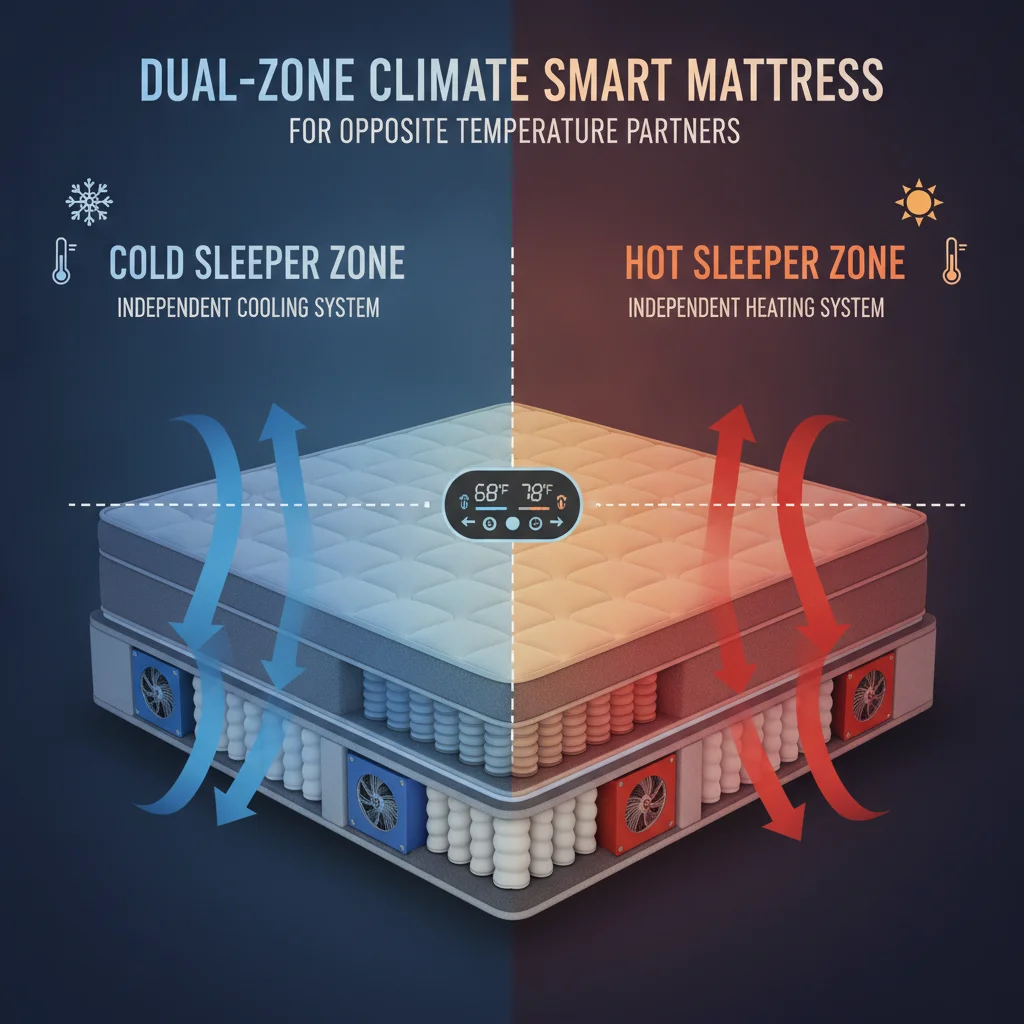
If you share a bed with someone who loves a warm cocoon while you wake up sweaty by 2 a.m., a generic “cooling mattress” rarely ends the argument. The use case that actually matches that fight is a smart mattress for couples different temperatures—true per-side heating and cooling, not one gel layer sold as climate control.
Most affiliate listicles blur those categories. They rank breathable foams next to water-cooled covers and call everything “great for couples.” In real bedrooms, one partner still steals the duvet while the other peels it off. Marketing photos of a serene couple do not measure whether side A can sit at a cool setting while side B stays warm.
We tracked opposite-preference couples across seasons with active dual-zone systems and with “cooling” mattresses that only change surface feel. The gap is not subtle. Dual-zone active climate control is the only smart-mattress feature that reliably solves opposite temperature preferences in the same bed.
- Shared cooling foam cannot hold opposite setpoints for two sleepers
- Preferred sleep temperature gaps of a few degrees feel huge overnight
- Duvet fights and middle-of-the-bed compromise erase weak climate claims
- App schedules matter as much as raw cooling power for couples
Couples with a 3–5°C preferred sleep temperature gap usually need true per-side heating and cooling—not a single cooling gel layer.
If your only problem is one hot sleeper and a partner who already sleeps fine, start with our best smart mattresses for hot sleepers. This guide is for the harder case: both of you need different climates on the same night.
How dual-zone smart mattress systems actually work
Dual-zone does not mean “two remotes for firmness.” It means each half of the bed can push heat in or pull heat out on its own schedule. Two engineering paths dominate 2026 shopping: water-based covers and air-chamber climate beds.
Water-based covers and hubs
Pod-class covers circulate temperature-controlled fluid through left and right zones. A hub beside the bed runs the loops, sensors watch skin or cover temperature, and the app lets each partner set a target without renegotiating the thermostat. Cover-only upgrades keep a mattress you already like; full stacks replace more of the sleep surface.
Strengths show up on opposite preferences: one side can cool hard while the other warms for winter feet. Weaknesses show up as hose routing, hub noise, and laundry care for a specialized textile. Long-term ownership quirks are covered in our Eight Sleep Pod 18-month review.
Air-chamber climate beds
Sleep Number-style systems combine adjustable air chambers with climate options on Climate360-class builds. Partners can change firmness and temperature per side, which helps when the fight is both “too soft / too firm” and “too hot / too cold.” The trade-off is complexity and price once you load climate hardware onto a full smart base.
What still bleeds across the center line
No dual-zone system creates a perfect thermal firewall. Body heat, a shared duvet, and cuddling at the start of the night move warmth across the midline. Expect improvement, not a hotel HVAC wall. Couples who insist on one heavy comforter often fight the hardware; split bedding or a lighter shared layer preserves more of the climate split.
- Independent schedules beat one shared “auto” profile for opposite partners
- Sensors help, but bedtime habits still move heat across the middle
- Firmness control is a bonus on air beds, not a substitute for climate
- Hub placement and pump noise can wake a light sleeper even when temperature is perfect
Best options for couples with different temperature needs
Shortlist by the size of your temperature gap, whether firmness is also contested, and how much recurring software cost you will tolerate. For a broader product map, see our Eight Sleep Pod vs Sleep Number comparison and the category overview of best smart mattresses we tested for sleep tracking.
Eight Sleep Pod-class dual-zone covers
Best when temperature is the primary fight and you want aggressive per-side heating and cooling. Couples who previously failed with gel foam and bamboo sheets usually feel the difference within the first week: the hot sleeper can drop their side without freezing the partner who wants warmth.
Watch subscription expectations. Automation and some couple conveniences may sit behind Autopilot-class plans. Confirm which dual-zone controls survive if you cancel. Price the two-year stack, not only the cover, using a full two-year ownership ledger for hardware, plans, and repairs—not just the cover sticker price.
Sleep Number Climate360-class builds
Best when one partner also needs firmer support or pressure relief that air chambers handle better than a cover alone. Climate360-class configurations aim at the same opposite-temperature problem with a different chassis: adjustable firmness plus climate, often with a heavier upfront bill and a different service model.
If your arguments are “too soft and too hot” on one side versus “too firm and too cold” on the other, this path can solve both axes. If temperature is the only conflict, a cover-only dual-zone upgrade is usually the cleaner experiment.
Budget dual pads and limited cases
Lower-cost dual cooling pads and smart toppers can help mild gaps—especially summer-only heat for one partner. They struggle when one sleeper wants active warming while the other wants strong cooling every night. Treat them as a trial, not a guarantee, when the preferred gap is large.
| Path | Best for | Weak for | Recurring cost risk |
|---|---|---|---|
| Pod-class dual-zone cover | Strong opposite heat/cool needs | Buyers who refuse hubs/subscriptions | High |
| Climate360-class air bed | Temperature + firmness fights | Shoppers who only need mild cooling | Medium |
| Dual cooling pad / topper | Mild summer gaps, tight budgets | Large opposite setpoints year-round | Low–medium |
| Single “cooling” foam mattress | One mildly warm sleeper | True hot-and-cold couples | Low |
Eight Sleep-style water covers and Sleep Number Climate360-class systems solve the same couple problem with different trade-offs on firmness, noise, and subscription cost. Pick the axis you fight about most nights, then accept the ownership model that comes with it.
What fails in real bedrooms for mixed-temperature couples
Hardware demos look clean. Shared bedrooms are not. Most disappointments we hear from opposite-temperature couples fall into three buckets: thermal bleed, noise/setup friction, and feature paywalls that quietly remove couple convenience.
Center-line bleed and duvet wars
If you keep one thick down comforter, you are asking the cold side to warm through a blanket that also traps heat on the hot side. Split toppers, dual duvets, or a lighter shared layer make dual-zone settings measurable. Without bedding changes, owners often blame the mattress for a problem the duvet creates.
Noise, hoses, and partner wake-ups
Hubs and pumps are quieter than early marketing critics claim—and still loud enough for light sleepers in a tiny room. Hose paths under a platform bed, closet placement with poor airflow, and aggressive temperature ramps at 3 a.m. all create wake events that undo sleep gains. Test schedules in the first two weeks; do not set maximum deltas on night one.
Subscription features that matter for couples
Independent schedules, gentle wind-down ramps, and some snore-response modes are exactly the features couples buy for. If those sit behind a membership, canceling can turn a dual-zone bed into a clumsier manual climate toy. Read the cancel path before you commit—especially if one partner will manage the app and the other will not.
- Bedding can erase dual-zone gains faster than firmware can fix them
- Light sleepers should evaluate hub noise in their actual room layout
- Confirm couple-critical features without a premium plan
- Snoring-related wake-ups may need a different feature set than climate alone—see our guide to smart mattresses for snoring couples
Setup tips that make dual-zone actually work
Buying dual-zone is step one. Configuring it like roommates who share a wall—not like a single thermostat—is step two.
Separate schedules and bedtime wind-down
Give each partner a profile with their own target and a gradual ramp into sleep. Sudden deep cooling on one side can pull heat across the middle and wake the warmer partner. Start with modest deltas for a week, then widen only if both sleep scores and subjective comfort improve.
- Baseline week: mild opposite settings, same bedding you will keep
- Adjust week: widen the gap 1–2 steps at a time
- Lock week: freeze schedules once both partners stop renegotiating at midnight
Bedding that protects the climate split
Prefer breathable sheets and avoid one oversized heated blanket. Dual duvets are underrated for opposite sleepers. If you insist on one cover, choose a lighter tog and let the mattress do the heating work for the cold partner.
When snoring or firmness needs overlap
Temperature is not always the only couple conflict. If firmness or snoring also wrecks nights, prioritize systems that address the combined problem instead of stacking three half-fixes. Dual-zone climate plus a firmness fight points toward air-chamber climate builds; dual-zone plus snore response points toward covers with partner-aware modes—validated carefully, not assumed from ads.
Data-focused couples who already wear Oura, Whoop, or Apple Watch should still judge success by morning conflict, not only by a recovery score. Tracking accuracy context lives in our piece on smart mattresses for data-driven sleepers; for this use case, the north star remains whether both of you stop mid-night temperature negotiations.
Who should skip dual-zone and what to buy instead
Dual-zone smart beds are expensive interventions. Skip them when a cheaper environmental fix will remove the conflict.
When HVAC and bedding are enough
If the room runs hot for both of you, fix airflow or AC first. If only one partner runs slightly warm in summer, a quality cooling topper or breathable bedding trial is rational before a multi-thousand-dollar hub. Dual-zone shines when preferences are opposite—not when the whole room is wrong.
Cover-only vs full bed swap
If you already like your mattress feel, a dual-zone cover is the lower-risk experiment. Full Climate360-class swaps make sense when firmness and climate both fail. Do not replace a comfortable mattress solely because an affiliate chart ranked a different brand higher for “couples.”
Budget decision framework for 2026
- Measure the gap: are preferences truly opposite, or is one person mildly warm?
- Fix the room and bedding: two weeks of honest trials
- Choose the axis: temperature-only → dual-zone cover; temperature + firmness → climate air bed
- Price ownership: hardware plus two years of plans, power, and repair reserve
A $400–$900 dual pad can be the right answer for mild seasonal gaps. A Pod-class or Climate360-class system is the right answer when opposite setpoints are a nightly, year-round conflict and cheaper layers already failed. Buying the expensive stack for a mild gap is how couples end up resenting a subscription they never needed.
Frequently Asked Questions
Can one smart mattress really cool one side and heat the other?
Yes—if it has true dual-zone active climate (separate fluid loops or climate chambers per side). A single gel foam layer marketed as cooling cannot hold opposite temperatures for two sleepers.
Is Eight Sleep or Sleep Number better for opposite temperature partners?
Eight Sleep-style covers usually win on aggressive per-side heating and cooling. Sleep Number Climate360-class systems pair climate with adjustable firmness. Pick based on whether temperature alone or firmness-plus-climate is the bigger fight in your bed.
Will a cooling mattress topper work for a hot-and-cold couple?
Sometimes for mild gaps if one partner only needs slight surface cooling. Large opposite preferences usually need dual-zone active climate, not a shared cooling topper.
Do dual-zone smart beds need a subscription to work for couples?
Basic per-side temperature often works without a premium plan, but automation, schedules, and some dual-zone conveniences may degrade if you cancel. Confirm which couple features survive without Autopilot-class memberships before you buy.
How big a temperature difference can dual-zone systems handle?
Most couples with a roughly 3–5°C preferred sleep gap do well. Extreme gaps plus a shared heavy duvet still fight the system—bedding and schedules matter as much as hardware.
Your next step
Stop shopping for a vaguely “cooling” mattress if your real problem is opposite preferences. Shortlist true dual-zone climate, change bedding so the split can stick, and price the subscription path honestly. That sequence beats another round of gel-foam marketing claims.
If temperature is the only fight, trial a dual-zone cover path first. If firmness and climate both fail, evaluate Climate360-class builds. Either way, success looks boring: both partners keep their settings, midnight renegotiations stop, and you stop treating the duvet like a peace treaty.
Related reading on our sister sites: Best Smart Lock for Home · Best Smart Ring for Endurance