People searching best smart humidifier for allergies usually want two things at once: less scratchy air in heating season, and zero extra mold in the bedroom. Those goals fight each other if you buy on “antimicrobial” stickers and then leave a tank wet for four days.
A humidifier does not treat allergic disease. It can make dry mucosa less miserable when indoor air is in the 20s for relative humidity, and it can make mites and mold happier if you push rooms into the 60s. This is comfort equipment with hygiene rules, not a substitute for a clinician’s plan, medication, or a real air purifier when particles are the problem.
We scored the same Levoit, Dyson, and Honeywell cluster already covered in our best smart humidifiers 2026 roundup and the Levoit vs Dyson vs Honeywell comparison, then re-ranked for allergy-relevant hygiene: tank access, dry-out, humidistat honesty, and whether the mist path can throw minerals at a stuffed nose.
The best smart humidifier for allergies is the one you will empty and dry, not the one with the longest antimicrobial marketing paragraph.
What a humidifier can and cannot do for allergy symptoms
Dry winter air makes many people feel congested even when pollen counts are zero. Adding moisture toward ~40–50% RH can ease that crackly feeling. It does not remove cat dander, and it does not cancel last August’s ragweed. If your worst days are outdoor pollen days with windows closed, a purifier plus cleaning may matter more than mist.
Dry air versus pollen, dust mites, and mold
Dust mites like humidity. Indoor mold likes humidity plus a cold wall. Pollen is a particle problem. A humidifier only changes water vapor. Allergy-relevant humidity is a band, not a maximum—most households do better targeting about 40–50% than running a unit until windows sweat.
- Dry-air irritation: humidify into the 40s, measured on a nightstand meter.
- Mite-heavy homes: do not park at 55%+ all winter “for comfort.”
- Musty rooms: fix leaks and ventilation first; a humidifier will advertise the problem.
Nursery constraints overlap—quiet tanks you can actually wash—see the nursery humidifier guide if the allergy household includes an infant.
Why “HEPA humidifier” listings confuse buyers
Some combo machines pass room air through a HEPA path and evaporate water. That can be a legitimate two-function device (Dyson’s pitch). Many Amazon titles slap “HEPA” on a wick that is not a certified particle filter. A wet pad is not a substitute for a purifier’s sealed filter path.
If particle allergy is the job, buy a purifier with a real CADR and a humidifier you will clean. If you want one appliance, budget Dyson-class money and still clean it on the calendar.
When a doctor’s plan outranks any appliance
Asthma action plans, immunotherapy, and prescribed sprays are medical. A smart plug and a Levoit are not. If humid air triggers wheeze for you, stop the experiment and talk to a clinician. We are describing household gear behavior, not diagnosing anyone.
How we scored allergy-relevant humidifiers
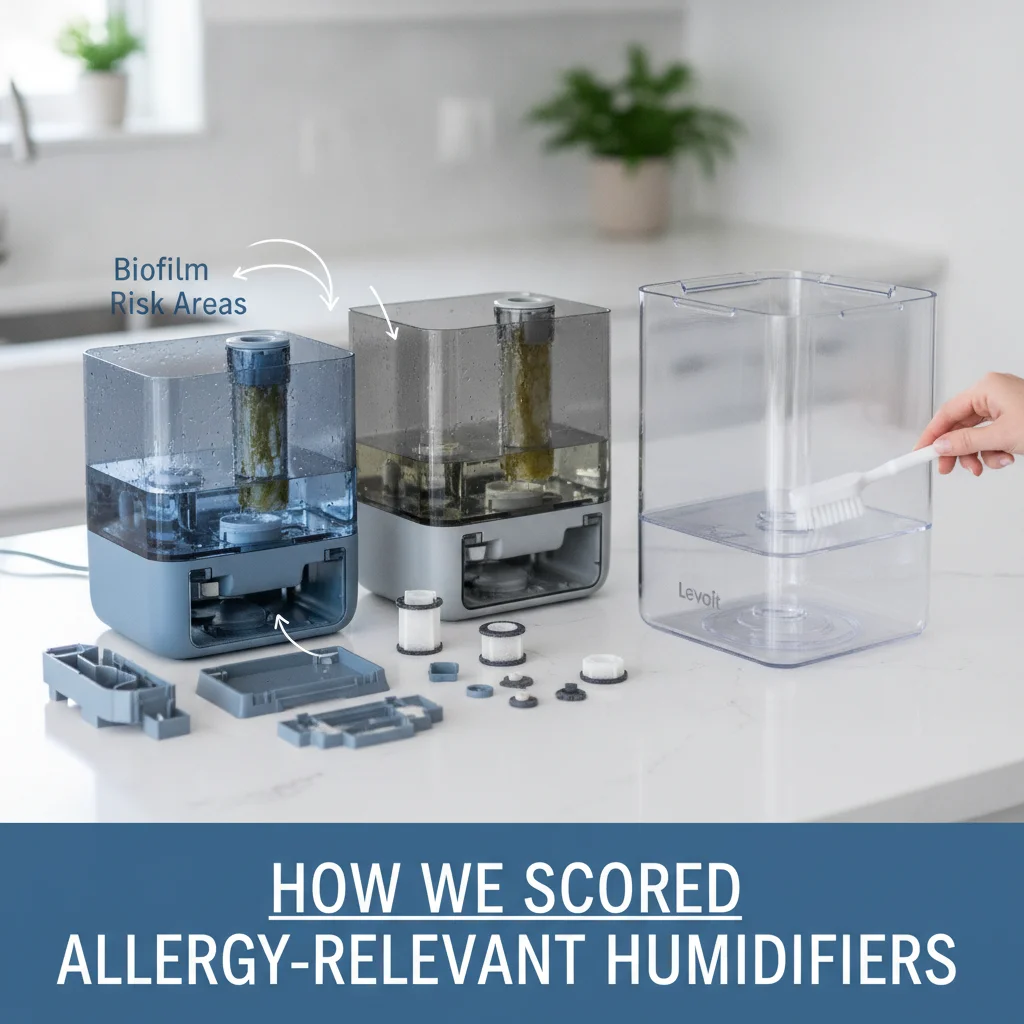
We weighted cleaning access and humidity stability above app polish. A dirty humidifier is an allergen machine: cool mist can aerosolize minerals and biofilm if the tank sits warm for days.
| Score axis | Why allergy households should care | What “good” looked like |
|---|---|---|
| Tank geometry | Biofilm hides in necks and ledges | Wide mouth, few gaskets, visible interior |
| Dry-out | Standing water overnight in a warm room | You can empty and air-dry in minutes |
| Humidistat | Overshoot feeds mites and window condensation | Holds ~40–50% without swamp cycles |
| Output type | Ultrasonic can throw mineral dust | Evaporative wick preferred for bedrooms |
| Noise | Units that get unplugged help nobody | Sleepable on low; see our bedroom humidifier for sleep notes |
Cleaning access and dry-out time
If a full empty-rinse-dry takes more than about ten minutes, people skip it. Sealed “looks clinical” tanks scored badly even when the brochure mentioned silver ions. Ions do not scrub a film you cannot reach with a bottle brush.
Levoit-style wide reservoirs won this axis. Dyson paths are more engineered and more annoying. Honeywell consoles vary; some trays are honest, some are a maze of wet cardboard smell.
Humidity stability without swamp cycles
Allergy use wants a band, not a blast. Smart auto mode is useful when the onboard sensor is not lying. We still keep a $12 hygrometer on the dresser. When the machine said 45% and the meter said 58% next to a cold window, we believed the meter and dropped the setpoint.
Output type: evaporative wick versus ultrasonic mist
Evaporative units humidify air that already passed a wet pad. They are slower and, with decent water, throw less white dust. Ultrasonic units are quieter on paper and can fog a room fast—along with whatever is in the tank. For allergy-sensitive airways, we default evaporative unless the user is militant about distilled water and daily dumps.
A dirty humidifier is an allergen machine: cool mist can aerosolize minerals and biofilm if the tank sits warm for days.
Ranked picks for allergy households in 2026
These are hygiene rankings, not a claim that any model “cures allergies.” If you will not clean a tank, do not buy a humidifier.
Levoit evaporative smart models: best default
For most allergy households, a Levoit-class smart evaporative humidifier is the best smart humidifier for allergies we would actually put in a bedroom. The tank is visible. Wicks are cheap enough that you will replace them when they smell. The app humidistat is good enough if you verify it.
Buy the room-size that matches a closed bedroom, not a living-room console you will never empty. Top-fill designs that still have a wide opening beat cute narrow towers you cannot inspect.
Skip random “aromatherapy” trays. Essential oils in a mist path are an irritant experiment, not an allergy feature.
Watch the wick smell. A sour pad is a discard, not a “rinse and keep.” Allergy households should treat odor as a hygiene fail the same way they would treat a musty sponge on the counter. Cheap wicks make that decision easy; expensive sealed pads make people bargain with a smell they should not bargain with.
If two people share the room and one is odor-sensitive, empty in the morning so the tank is dry all day. Night-only runtime still needs that dry-out. “Always full so it is ready” is how biofilm wins.
Dyson humidify-cool combos: premium if you will maintain them
Dyson makes sense when you already want a sealed purifier in the same footprint and you will run the cleaning cycle like a medication reminder. Evaporative humidification plus HEPA is a coherent story. It is a bad story if the machine becomes furniture because the pad ritual feels like printer maintenance.
Allergy-wise, the win is controlled humidity plus particle filtration in one column. The loss is complexity: more surfaces, official pads, and a higher chance you delay a cleaning. Premium only if your household is the type that keeps a calendar.
Place a Dyson combo where you will actually run both functions. A hallway trophy that never humidifies is an expensive purifier. A bedroom unit that humidifies on high while the HEPA is clogged is the opposite of an allergy setup. Check both consumables. Do not let the prettier job hide the wet one.
If you travel often, Dyson’s “leave water in it” temptation is worse than a $90 tank you feel guilty wasting. Dump before you leave. A three-day business trip in a sealed wet machine is a classic Monday mold surprise.
Honeywell and closed-tank budget units: higher mold tax
Large Honeywell evaporative consoles can humidify a dry great room. They are harder to keep in the allergy-safe band because people set them high and forget them. Budget ultrasonics with tiny fill holes are the worst of both worlds: mineral dust plus biofilm you cannot see.
If money is tight, a simple wide-tank evaporative Levoit-style unit still beats a $40 closed ultrasonic “for allergies” listing. Hygiene beats features.
Mold, minerals, and the dirty-humidifier backlash
Most horror stories are maintenance stories. The machine did what wet plastic does at 72°F.
Biofilm timelines in real bedrooms
Standing tap water in a closed tank can smell off within several days in a warm room. Visible slime showed up faster on units that were “always ready” with yesterday’s water. Daily empty in winter duty is the rule we kept. Weekly deep clean is the second rule. If that sounds like too much, you do not want a humidifier—you want a kettle and a closed bathroom door after showers, which is a weaker but simpler humidity bump.
White dust and irritated airways
Ultrasonic mist can leave a film on nightstands. That dust is minerals, not “toxins” as social posts claim, but it is still junk in the breathing zone. People with reactive airways often feel worse and blame “the humidifier” when they mean “the misted kettle scale.” Use evaporative output or distilled water if you insist on ultrasonic.
What “antimicrobial” actually covers
Silver-treated wicks and UV lights are marketing layers on top of physics. They do not replace emptying. They may slow growth on a treated surface while the untreated lid gasket grows anyway. Score them as a minor plus, never as permission to skip drying.
Allergy-relevant humidity is a band, not a maximum—most households do better targeting about 40–50% than running a unit until windows sweat.
A setup protocol that keeps humidity helpful
Protocol beats product. The same Levoit is either a comfort tool or a science fair depending on this list.
Target range and placement
Set auto toward 40–45% to start. Place the unit so mist or moist air does not blow on bedding, a crib rail, or a cold exterior wall. Keep it off the carpet if the model spits. Verify with a second hygrometer across the room, not only on the machine.
Daily empty, weekly wash, seasonal pad change
Empty in the morning or at refill. Weekly: vinegar or citric on tank and tray, rinse, dry. Change wicks when they stiffen, brown, or smell, faster on hard water. Store dry in spring. This is the same discipline as our maintenance-cost page logic: skipped cleaning becomes a replacement tank, which is a worse allergy outcome than a $20 wick.
- No oils in the water path.
- No “top off” on old water.
- No running until the windows weep.
When to turn it off during pollen or damp weeks
If outdoor humidity is already high, or you are mopping condensation, unplug. During peak pollen, prioritize filtration and closed windows over extra indoor moisture. A humidifier is a winter-dry tool in most of the U.S. heating belt, not a year-round identity.
Buy for the chore you will do. That is the entire allergy ranking.
If you want a single shopping sentence: start with a wide-tank evaporative smart humidifier, verify 40–50% with a separate meter, and pair it with a real purifier if particles are the complaint. That combination beats a “best smart humidifier for allergies” listing that hides a dirty ultrasonic tank behind a HEPA adjective.
Re-check in week three, not on unboxing day. The unit that still looks clean, still holds a humidity band, and still gets emptied is the one that belongs in an allergy household. The unit that has a film on the lid already lost, regardless of brand.
Frequently Asked Questions
What is the best smart humidifier for allergies?
The best smart humidifier for allergies in our tests was an easy-clean evaporative Levoit-style unit with a working humidistat, not a sealed ultrasonic novelty. Allergy benefit depends on holding roughly 40–50% relative humidity and keeping the tank free of biofilm. A Dyson combo can work if you follow its cleaning calendar; a hard-to-open budget tank usually does not.
Can a humidifier make allergies worse?
Yes. Over-humidifying feeds dust mites and indoor mold. A neglected tank can put contaminated mist into the room. If you wake stuffier after running the unit, check humidity with a separate meter and inspect the tank before you blame pollen.
Is warm mist better for allergy sufferers?
Warm mist is not inherently hypoallergenic. It can reduce some microbes with heat, but it adds burn risk and still needs cleaning. We prefer cool evaporative units with wide tanks for bedrooms and nurseries, plus a strict empty-and-dry habit.
Do I need a humidifier and an air purifier?
They do different jobs. A purifier can capture some airborne particles; a humidifier only adds moisture. Combo Dyson units try both, at a price. Many allergy households do better with a dedicated purifier plus a simple evaporative humidifier they will actually clean.
What humidity level helps dry sinuses without feeding mites?
Aim for about 40–50% in the breathing zone, measured away from the vent. Below ~30% many people feel crackly mucosa. Above ~55–60% you raise mite and mold risk on cold walls. Use auto mode tied to a real hygrometer, not a forever-on dial.
Related reading on our sister sites: Best Motorized Window Shades and · Best Walking Pad Standing Desk