Shoppers hunting smart humidifier filter replacement cost over 2 years are not asking what the Amazon listing costs on day one. They are asking whether a $80 Levoit, a $250 Honeywell stack, or a $700 Dyson still looks rational after two heating seasons of wicks, descaler, and Tuesday-night tank scrubs.
We already ranked bedroom performance in our best smart humidifiers 2026 guide and put the three big brands next to each other in the Levoit vs Dyson vs Honeywell comparison. This page isolates money: filters, cleaning supplies, and the parts you replace when plastic fatigues.
Filter cost is a water-hardness tax: the same Levoit wick that lasts a heating season in soft water can clog in eight weeks on well water. Numbers below are household tracking across dry-winter bedrooms, not a lab coupon test. Your gallons-per-day and grain hardness will move every cell.
What the box price hides
Humidifier marketing sells “whisper quiet comfort.” The invoice that shows up later is consumables plus time. Evaporative smart units need a wet pad or wick that loads with minerals. Ultrasonic units skip that SKU and bill you in descaler, extra tanks, and furniture wiping when white dust appears.
Runtime matters more than model year. A nursery unit that runs 14 hours a night from November through March will eat pads faster than a living-room unit used only when the furnace is blasting. Two identical SKUs can post different two-year bills if one house has a steam humidifier on the HVAC and the other is 12% indoor RH in January.
Purchase price versus winter runtime
Treat the sticker as a down payment. A $70 evaporative humidifier that needs a $20 wick six times a winter is a $190 first-year machine before vinegar. A $550 Dyson that needs one official evaporative pad per season can still be cheaper in cash if you actually buy the pad instead of running a clogged one until output dies.
Hours are the hidden multiplier. We logged roughly 1,200–1,800 humidifier-hours per winter in forced-air bedrooms. That is the band these costs assume. Cut hours in half with a whole-home humidifier and your wick spend collapses.
- Low use (guest room, occasional dry spells): filters may last the printed interval.
- Bedroom winter duty: expect 1.5–3× the box “replace every 3 months” claim on hard water.
- 24/7 nursery: budget the high end of every table below, and read the nursery humidifier guide for noise and safety constraints that also affect which tanks you will actually empty.
Wick, HEPA-adjacent, and evaporative pads are not interchangeable
Listing photos mash three products together. A cardboard evaporative wick is a mineral sponge. A Dyson-style sealed pad is a branded evaporative media with a different price and a different clog curve. A “HEPA” add-on on some combo units is an air-path filter, not a stand-in for the wet media. You can spend $40 on the wrong rectangle and still have a brown wick starving output.
Smart features do not change the physics. An app reminder that says “replace filter” is useful only if the SKU is in stock. Error codes that mean “pad exhausted” are still a parts invoice.
Hard water is the real multiplier
Municipal soft water lets some owners stretch a Levoit wick across a full heating season with monthly vinegar soaks. Well water at 15–25 grains can brick the same wick in 6–8 weeks. That is not a brand defect. It is dissolved calcium moving into cellulose.
Filter cost is a water-hardness tax: the same Levoit wick that lasts a heating season in soft water can clog in eight weeks on well water.
If your kettle crusts in a week, assume the high column in the table. Distilled or RO water can flatten that curve. It is not free; we cover break-even later.
Two-year filter and supply bills by brand
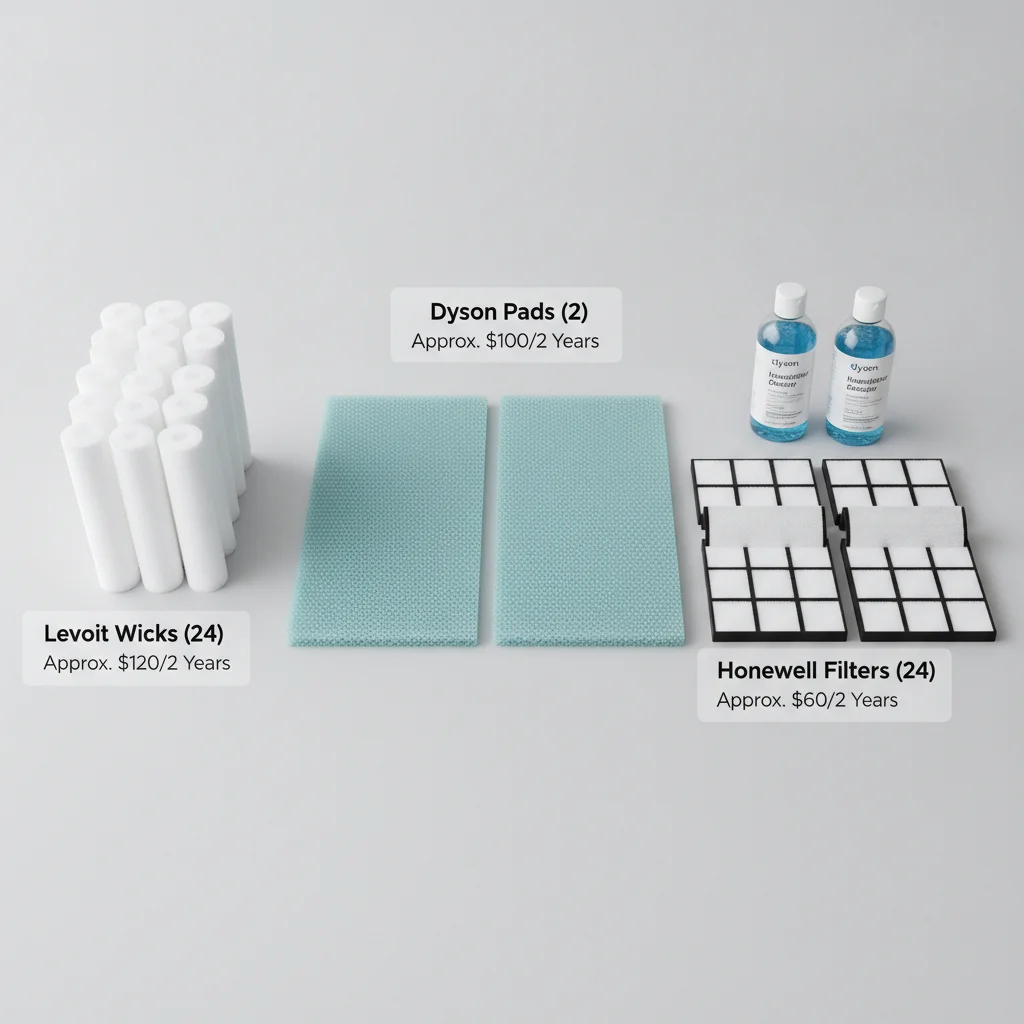
These ranges include replacement media plus a realistic descaler/vinegar budget. They exclude electricity, which is small on evaporative fans, and they exclude your time. They assume two winters of bedroom use, not a unit that sat in a closet.
| Household pattern | Typical 2-year media + chemistry | What drives the spread |
|---|---|---|
| Levoit evaporative (Classic-style wick) | $80–180 | Wick $12–25; 4–10 changes; vinegar mostly |
| Dyson humidify / evaporative pad | $90–220 | Official pads $40–80; fewer changes; branded cleaner |
| Honeywell / box-store wick stack | $150–300 | Monthly wicks in hard water; easy to over-buy packs |
| Ultrasonic “no filter” smart tank | $40–120 + cleaning time | Descaler, optional demineralization cartridge, extra tanks |
A cheap Honeywell that needs a $18 wick every month can outspend a $400 Dyson on consumables before the second winter ends. That sentence is the whole category, restated as arithmetic.
Levoit: cheap machine, predictable wicks
Levoit’s smart evaporative models won our value testing because output and app humidity tracking stay useful while the wick is alive. The aftermarket is deep. That is good and dangerous: counterfeit wicks collapse faster, and genuine two-packs still add up if you treat “replace when brown” as “replace on the first Tuesday.”
Soft-water owners in our notes bought 4–6 wicks across two winters plus a jug of distilled white vinegar. Hard-water owners bought 8–10 and still had a week of sad mist at the end of each pad. Neither group needed a branded “Levoit cleaner” subscription.
Budget a tank. Lids crack, and mineral rings make people throw out a working base. A replacement tank is often $20–40—cheaper than a new unit, easy to forget when you are comparing filter SKUs only.
Dyson: fewer SKUs, steeper parts
Dyson humidify-cool machines sell purification theater and a sealed evaporative path. Official pads cost more per change and less often if you keep water clean. When a pad is out of stock, you do not have a grocery-store analog. That scarcity is a cost: people run expired media or abandon the humidify function and own a loud fan.
Two-year cash can still beat Honeywell if you buy one pad per winter and use the cleaning cycle as designed. It loses if you also buy Dyson’s bottled cleaner at prestige pricing when vinegar would have done the limescale job on the accessible parts. Read the manual for what vinegar is allowed to touch. Silver-treated evaporative media is not a license to skip emptying.
If the machine is also your purifier, do not double-count HEPA life as humidifier TCO. Those are air-path filters. Mixing the invoices is how Dyson ownership threads turn into $400 “filter years.”
Honeywell and box-store wicks: death by monthly filters
Honeywell evaporative consoles are easy to find and easy to feed. The wick is a commodity rectangle. In hard water it becomes a monthly SKU. Multi-packs look cheap until you realize you are on wick seven in March.
Smart variants add a humidistat that helps you not over-run. They do not shrink mineral load. If you like the brand for a large living room, price two winters of wicks next to a Levoit bedroom unit plus a closed door. Room-size matching saves more money than loyalty to a console that drinks filters.
For sleep-specific noise and humidistat behavior, our bedroom humidifier for sleep notes still apply: a cheaper wick stack that rattles will get turned off, which is the most expensive “saving” of all—you bought media and still wake dry.
Time, descaler, and parts that are not filters
Cash is half the TCO. The other half is whether you will keep doing the chore. A $15 wick you never install because disassembly takes 20 minutes is a $0 line item and a moldy tank.
Vinegar versus branded descaler
Distilled white vinegar handled most Levoit and Honeywell mineral films in our sinks. Citric acid powder is useful when vinegar smell bothers a nursery. Branded descalers earned their keep mainly on Dyson-accessible channels where the manual is picky, and on ultrasonic base plates with stubborn scale.
Two-year chemistry: $10–25 for vinegar/citric in evaporative homes, $25–60 if you default to brand bottles. That is not the scary number. The scary number is replacing a tank because nobody descaled for 14 months.
- Weekly: empty, rinse, dry the lid area.
- Every 1–2 weeks in winter: vinegar soak on the tank and any removable tray.
- Pad change: when output drops or the wick is crunchy, not when the app nags on a calendar if water is soft.
Cracked tanks, warped lids, and dead hygrometers
Plastic fatigue showed up after year one on budget lids left in a sunny window. Internal humidistats drifted. Smart auto mode then over-humidified and wasted water—and pads. A $12 hygrometer on the nightstand is cheaper than trusting a tired sensor.
Replacement tanks and lids are the “oops” SKUs. If your model is already discontinued, those parts become the reason you retire the base. Check parts availability the day you buy, not in month 20.
App-only error codes that mean “buy a pad”
Smart reminders are useful when they map to a real SKU. They are expensive when they lock output until you scan a QR code for an official pad that is on backorder. That is a Dyson-class risk more than a Levoit-class risk.
If you skip weekly emptying, you are not saving money—you are buying biofilm and a tank you will replace anyway. Apps cannot smell that. You can.
If you skip weekly emptying, you are not saving money—you are buying biofilm and a tank you will replace anyway.
How to cut ownership cost without starving humidity
The goal is stable 40–45% in the bedroom, not a heroic mist cloud. Lower setpoint plus a closed door often beats a bigger console and a bigger wick.
Distilled or filtered water when it actually pays off
Run the napkin math. If a wick is $18 and distilled water is $1.20/gallon, and the unit uses ~2 gallons/night, distilled is ~$2.40/night. That only wins if it truly doubles or triples wick life and you were on a monthly wick cadence. On soft city water, distilled is usually a lifestyle preference, not a saving.
Pitcher filters and fridge dispensers help a little. They do not match RO. Well-water households saw the clearest wick-life gains from RO or distilled. Everyone else should try vinegar discipline first.
Seasonal storage so pads do not rot
April storage is where people create September mold. Empty completely, dry the tank for 48 hours open, bag or bin the dry spare wicks so they do not sit damp. A rotten spare pack is a silent $40.
Do not leave a “ready” tank with water for the first cold snap. That is a biofilm starter kit.
When a higher sticker price is the cheaper path
Pay up when: (1) official media lasts a season and you will buy it, (2) the tank opens wide enough that you will clean it, (3) the humidistat is trustworthy so you do not over-run. Pay down when aftermarket wicks are cheap and you accept a monthly Amazon order.
Do not pay a Dyson premium solely to avoid filters if you will ignore the cleaning cycle. You will still buy pads, and you will still own a complicated plastic maze.
Who should buy which cost profile in 2026
Match the bill to the water and the room, then pick a brand. Reverse that order and you will screenshot this table in February, angry.
Soft-water apartments
Levoit-style evaporative smart units remain the default. Two-year media stays in the $80–140 band if you empty weekly. Skip filter subscriptions. Buy wicks two at a time when they dip on sale.
Well water and forced-air winters
Price distilled/RO plus a simple wick, or accept Honeywell-level monthly spend. This is the case where a higher Dyson-class pad interval can win on cash—if parts stay in stock. Test hardness. Guessing is how people buy the wrong stack.
A cheap Honeywell that needs a $18 wick every month can outspend a $400 Dyson on consumables before the second winter ends.
Nurseries and light sleepers who will not skip cleaning
Buy the tank you will disassemble at 9 p.m., not the quietest spec sheet. Consumable cost is wasted if the unit is unplugged after a mold scare. Wide-mouth evaporative tanks beat sealed “looks medical” reservoirs that you cannot see into.
If you only remember one number, remember this: smart humidifier filter replacement cost over 2 years is usually a three-digit line item, and water plus emptying habits decide whether it is closer to $80 or $300. The box price is just the entry fee.
Frequently Asked Questions
How much is smart humidifier filter replacement cost over 2 years?
In our household tracking, smart humidifier filter replacement cost over 2 years landed roughly $80–180 for careful Levoit owners, $90–220 for Dyson evaporative pads and occasional parts, and $150–300 for Honeywell-style monthly wicks in hard water. Water hardness and hours run move those bands more than the brand logo.
Do ultrasonic humidifiers avoid filter costs?
They avoid wick SKUs, not maintenance. You still buy descaler, extra tanks if mineral dust coats furniture, and sometimes a demineralization cartridge. White dust is a cost in cleaning time even when Amazon shows “no filters required.”
Are manufacturer filter subscriptions cheaper?
Subscriptions only help if you would otherwise over-order or forget and run a clogged pad until output collapses. Auto-ship at full price is not a discount. Check the per-pad math against a two-pack from the same SKU before you enroll.
Does distilled water pay for itself?
On very hard well water, distilled or RO water can double wick life and cut descaling. On already-soft municipal water, the jug cost often exceeds the filter savings. Weigh $/gallon against how often you currently toss a brown wick.
When is it cheaper to replace the whole humidifier?
If the tank is cracked, the hygrometer reads nonsense, or official pads are discontinued, a new value evaporative unit can beat two more years of scavenged filters. Do not keep a moldy tank alive to “save” a $20 wick.
Related reading on our sister sites: Electric Composter Total Cost Ownership · Standing Desk After 2-3 Years