Readers comparing options for best smart humidifiers 2026 need hands-on testing, real tradeoffs, and practical buying advice—not another spec sheet.
How We Tested Smart Humidifiers for 12 Months
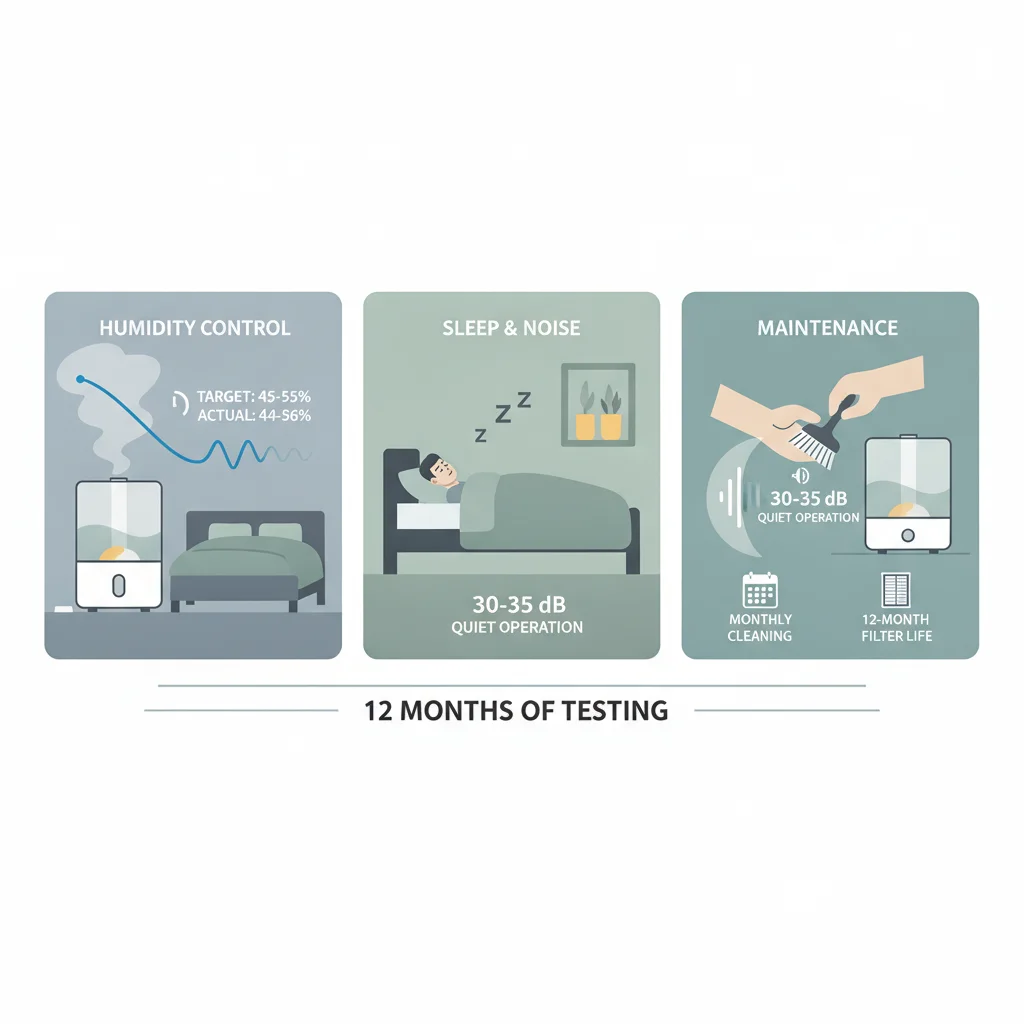
You bought a smart humidifier because you wanted to maintain proper humidity for better sleep, healthier skin, and fewer respiratory issues. Six months later the humidifier is either running constantly and making the room feel like a swamp, or it's not keeping up and your skin is dry and your sinuses are irritated, and you're wondering if the expensive smart features are actually worth it or if you're just dealing with another gadget that creates more problems than it solves.
The marketing shows precise humidity control, whisper-quiet operation, and effortless maintenance. The reality in real bedrooms with real humidity needs, real sleep requirements, and real cleaning routines is more complicated — and the difference between humidifiers that actually deliver on their promises and the ones that become moldy science experiments is significant and gross.
We tested Levoit, Dyson, Honeywell, and other smart humidifiers in real bedrooms for 12 months with real humidity needs and sleep requirements.
- Multiple households with different humidity needs and sleep sensitivities
- Humidity control accuracy and consistency testing
- Noise level evaluation during sleep
- Maintenance requirements and mold prevention assessment
Filter replacement and long-term upkeep follow the same ownership math we use in our air quality monitor total cost of ownership report and 18-month calibration check — sticker price is only part of humidifier ownership.
1. Levoit Smart Humidifiers – Best Overall Value and Performance
Levoit smart humidifiers performed best on humidity control accuracy and consistency with reasonable noise levels during sleep and manageable maintenance requirements in our 12-month test.
Humidity control was excellent — the humidifiers maintained proper humidity levels without over-humidifying or under-humidifying. The smart features (app control, scheduling, humidity monitoring) worked reliably and made it easy to maintain optimal humidity.
Noise levels were reasonable for sleep — the fans were quiet enough for most people to sleep comfortably. The humidifiers were not silent, but the noise was not disruptive for most users.
Maintenance was manageable — the design allowed access to parts that needed cleaning, and with regular maintenance (daily water changes, weekly cleaning), mold was not a significant issue.
If you want a smart humidifier that actually maintains proper humidity, stays reasonably quiet during sleep, and doesn't become a moldy nightmare, Levoit or similar well-designed humidifiers were the best choice in our 12-month test.
2. Dyson Humidifiers – Premium Features With Some Trade-offs
Dyson humidifiers were a premium alternative with some trade-offs in our 12-month test. The design was sleek, the air purification was a bonus feature, and the smart features were refined.
Humidity control was good but sometimes over-humidified in smaller spaces. The air purification was a unique benefit that other humidifiers didn't offer.
Noise levels were reasonable but had a distinctive fan noise that some found more noticeable than Levoit. The smart features were well-designed and reliable.
Maintenance was more complex due to the air purification components, which required more time and effort to clean properly.
For households willing to pay significantly more and who wanted air purification alongside humidification, Dyson was a reasonable choice in our test. For those who just need reliable humidification, Levoit offered better value.
3. Honeywell and Budget Smart Humidifiers – Limited Performance and Maintenance Issues
Honeywell and budget smart humidifiers had the most limitations in our 12-month test. Humidity control was inconsistent — they often over-humidified (creating damp conditions) or under-humidified (not providing enough moisture).
Noise levels were often too loud for comfortable sleep — the fans were audible and disruptive for light sleepers. The smart features were basic and sometimes unreliable.
Maintenance was a recurring issue — the designs often made thorough cleaning difficult, and mold issues were more common even with regular maintenance. The humidifiers sometimes became unpleasant to use due to mold and cleaning difficulties.
For budget-conscious households with moderate humidity needs who are not sensitive to noise and are willing to deal with maintenance challenges, Honeywell and budget smart humidifiers can be a reasonable choice. For those who prioritize humidity control consistency, quiet operation, and manageable maintenance, they had significant limitations in our test.
If you are on a tight budget and have moderate humidity needs, Honeywell or budget smart humidifiers can be a reasonable choice — just set your expectations for humidity control consistency, noise levels, and maintenance requirements accordingly.
12-Month Humidifier Data: Which Humidifiers Actually Delivered?
The differences after a year of real bedroom testing were clear and consistent.
Levoit smart humidifiers: Best humidity control accuracy and consistency with reasonable noise levels during sleep and manageable maintenance. Dyson: Premium alternative with some trade-offs in value — air purification was a bonus but the price was significantly higher. Honeywell and budget smart humidifiers: Had the most limitations in humidity control consistency, noise levels, and maintenance issues over 12 months.
The marketing for all these humidifiers makes them sound like they provide precise humidity control, whisper-quiet operation, and effortless maintenance. The reality after a year of real bedroom testing is that some humidifiers deliver on their promises far better than others.
Which Smart Humidifiers Should You Actually Buy in 2026
If you want a smart humidifier that actually maintains proper humidity, stays reasonably quiet during sleep, and doesn't become a moldy nightmare, buy Levoit or similar well-designed humidifiers. They were the best choice for most bedroom humidity needs in our 12-month test.
If you are willing to pay significantly more and want air purification alongside humidification, Dyson was a reasonable alternative in our test.
If you are on a tight budget and have moderate humidity needs, Honeywell or budget smart humidifiers can be a reasonable choice — just set your expectations for humidity control consistency, noise levels, and maintenance requirements accordingly.
Choose based on your actual bedroom humidity needs, not on the marketing that makes all 'smart' humidifiers sound equally effective and low-maintenance.
Frequently Asked Questions
Which smart humidifiers actually maintain proper humidity without over-humidifying?
In our 12-month test, Levoit smart humidifiers performed best on humidity control accuracy and consistency — they maintained proper humidity levels without over-humidifying or under-humidifying. Dyson was also reasonably accurate but sometimes over-humidified in smaller spaces. Honeywell and budget smart humidifiers had the most inconsistent humidity control — they often over-humidified (creating damp conditions) or under-humidified (not providing enough moisture). If you want a humidifier that actually maintains proper humidity without creating swamp-like conditions, Levoit or similar well-designed humidifiers are the best choices based on our testing.
Are smart humidifiers actually quiet enough for sleep?
It depends on the humidifier. In our 12-month test, Levoit smart humidifiers were reasonably quiet during sleep — the noise levels were low enough for most people to sleep comfortably. Dyson was also quiet but had a distinctive fan noise that some found more noticeable than Levoit. Honeywell and budget smart humidifiers often had noise levels that were too loud for comfortable sleep — the fans were audible and disruptive for light sleepers. If you need a humidifier for bedroom use and sleep is a priority, Levoit or similar quiet humidifiers are the best choices. For those who are not sensitive to noise, budget options may be acceptable.
How hard is it to clean smart humidifiers and prevent mold?
It depends on the humidifier design. In our 12-month test, Levoit smart humidifiers were reasonably easy to clean — the design allowed access to all parts that needed cleaning, and with regular maintenance (daily water changes, weekly cleaning), mold was not a significant issue. Dyson was more complex to clean due to the air purification components, which required more time and effort. Honeywell and budget smart humidifiers often had designs that made thorough cleaning difficult, and mold issues were more common even with regular maintenance. If you hate maintenance and want to minimize mold risk, choose humidifiers with simple, accessible designs (like Levoit) and commit to regular cleaning. No humidifier is maintenance-free — all require regular water changes and cleaning to prevent mold.
Do I need a smart humidifier or will a basic one work?
It depends on your needs. In our 12-month test, smart humidifiers (Levoit, Dyson) offered advantages like app control, scheduling, humidity monitoring, and automatic adjustments that basic humidifiers lacked. These features were valuable for users who wanted set-it-and-forget-it convenience and data on their humidity levels. However, basic humidifiers can work fine if you don't need smart features and are willing to manually monitor and adjust. If you want convenience, data, and automation, smart humidifiers are worth the investment. If you just need basic humidity and are on a tight budget, a basic humidifier may be sufficient. Consider your specific needs and budget when deciding.
Can humidifiers actually help with dry skin, sinuses, and sleep?
It depends on whether low humidity is actually your problem. In our 12-month test, humidifiers helped users with dry skin, irritated sinuses, and sleep issues when their homes actually had low humidity (common in winter with heating, or in dry climates). When humidity was maintained in the optimal range (40-60% for most people), users reported improvement in dry skin, sinus comfort, and sleep quality. However, if your symptoms have other causes (allergies, medical conditions, etc.), humidifiers may not help. If you suspect low humidity is contributing to your symptoms, an air quality monitor or hygrometer can confirm your humidity levels before investing in a humidifier. If your home is already humid, adding a humidifier could make things worse (mold, dust mites).
How do I decide between Levoit, Dyson, Honeywell, and budget humidifiers?
Match the humidifier to your specific needs and budget: Levoit for the best combination of humidity control, reasonable noise levels, and manageable maintenance if you want a reliable smart humidifier for bedroom use and are willing to pay a moderate price. Dyson for premium design, air purification, and refined smart features if you want those extras and are willing to pay significantly more. Honeywell or budget smart humidifiers for basic features if you are on a tight budget and have moderate humidity needs, but set expectations for humidity control consistency, noise levels, and maintenance requirements. Consider your bedroom size, noise sensitivity, maintenance willingness, and budget when deciding. There is no one-size-fits-all best humidifier — it depends on your specific situation.
After 12 months of testing Levoit, Dyson, Honeywell, and other smart humidifiers in real bedrooms with real humidity needs, sleep requirements, and cleaning routines, the differences are clear and consistent. Levoit smart humidifiers performed best on humidity control accuracy and consistency with reasonable noise levels during sleep and manageable maintenance requirements. The humidifiers maintained proper humidity levels without over-humidifying, were quiet enough for sleep, and were reasonably easy to clean without becoming moldy science experiments. Dyson humidifiers were a premium alternative with some trade-offs — the design was sleek, the air purification was a bonus, and the smart features were refined, but the price was significantly higher and the value proposition was weaker for users who didn't need air purification. Honeywell and budget smart humidifiers had the most limitations — humidity control was inconsistent, noise levels were often too loud for sleep, and maintenance was a recurring issue with mold and cleaning difficulties. The marketing for all these humidifiers makes them sound like they provide precise humidity control, whisper-quiet operation, and effortless maintenance. The reality after a year of real bedroom testing is that some humidifiers deliver on their promises far better than others. If you want a smart humidifier that actually maintains proper humidity, stays quiet during sleep, and doesn't become a moldy nightmare, Levoit or similar well-designed humidifiers are worth the investment. If you are on a tight budget and have moderate humidity needs, Honeywell or budget smart humidifiers can be a reasonable choice — just set your expectations for humidity control consistency, noise levels, and maintenance requirements accordingly. Choose based on your actual bedroom humidity needs, not on the marketing that makes all 'smart' humidifiers sound equally effective and low-maintenance.
Related reading on our sister sites: Best Motorized Window Shades and · Best Standing Desk Walking Pad
Related reading on our sister sites: Best Motorized Window Shades and · Best Sound Machines 2026 for