The useful aerogarden vs click and grow 2026 question is which watering method you will live with: a silent wick in a 4-liter tank, a 9-pod hydroponic bowl with a pump, or a 30-plant tower that needs Wi-Fi. Gardyn shows up in the same tab even when the search box only names the two countertop brands.
This comparison uses the current US product pages from Click & Grow, Scotts Miracle-Gro’s AeroGarden Bounty listing, and Gardyn’s Home kit shop, plus WIRED’s September 2026 indoor-garden gallery and Gardyn’s own pump troubleshooting article. Category ranking for other towers and budget kits sits on the published smart indoor garden 2026 hub.
Buy Click & Grow Smart Garden 9 if you want nine plants, no pump, and you will pay about $15 per three-pack of official pods. Buy AeroGarden Harvest or Bounty if you want liquid nutrients, aftermarket sponges, and 12–24 inches of light height. Buy Gardyn Home 4 only if you have a 24×12-inch floor patch, will empty a tank on a calendar, and accept a membership if you want Kelby and cheap yCubes.
How each garden waters, lights, and feeds plants
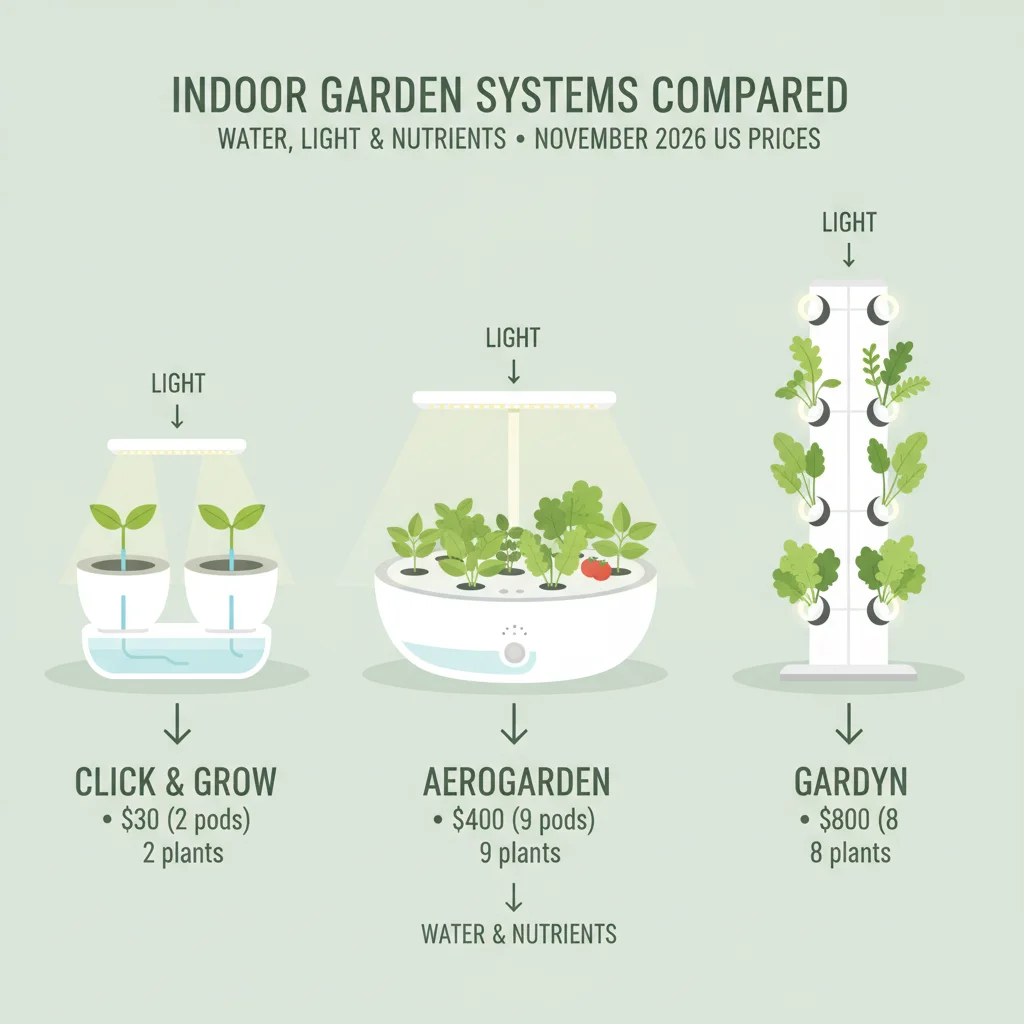
Click & Grow’s Smart Garden 9 is not a circulating hydroponic. Official copy says plant pods sit in cups with wicks, the 4-liter (1.06 US gal) tank is filled every 1–3 weeks, LEDs run 16 hours on and 8 hours off, and there is no pump. Power is listed at 13 W and 6.2 kWh per month. Setup is “add pods, add water, plug in.” Nutrients live in the coconut-coir “smart soil,” not in a bottle you dose into the tank.
AeroGarden Bounty is the opposite plumbing. Scotts lists a 9-pod bowl, a 40 W LED bar, Wi-Fi, a color touchscreen, water and plant-food reminders, vacation mode, and 24 inches of adjustable grow height. The box includes a 9-pod seed kit, a 3-fl oz bottle of liquid plant food, and a 6-inch trellis. WIRED’s 2026 Bounty notes say the pump runs about every 30 minutes, lights stay on about 16 hours, and a nutrient reminder light flashes every two weeks on the smaller Harvest Lite as well.
Gardyn Home 4 is a vertical loop. The shop table lists 30 plant sites, a 24″ W × 12″ D × 64″ H tower (about 2.0 sq ft), two 40 W LED bars, two inward cameras, water/humidity/temperature sensors, and 2.4 GHz Wi-Fi only. Water is pumped up the columns and trickles back to the tank. Seeds ship in yCubes (mineral wool in a compostable cup) that drop into yPods. Membership unlocks Kelby, the camera-and-sensor coach; the hardware still waters and lights on a schedule without it.
What “smart” actually automates
Click & Grow automates photoperiod and watering physics. The app is optional plant-care tips and harvest reminders. The float in the tank is the water gauge. There is no nutrient blinker because there is no separate nutrient step on official pods.
AeroGarden automates the light timer and nagging. You still pour liquid food on the interval the panel requests and you still raise the bar so leaves do not fry against the LEDs. WIRED kept the Bounty app for about a week, then dropped it after the app repeatedly “forgot” the garden; the on-unit screen still ran the schedule.
Gardyn automates a denser stack: lights, pump cycles, and, with Kelby, coaching from cameras. That is also a dependency. Gardyn’s FAQ is explicit that membership is not required to run lights and watering, but Vacation Mode, Ask Kelby, and cheap plant credits sit behind the paywall.
Footprint, plant count, and what the light height allows
Counter width is the first filter. Click & Grow lists the Smart Garden 9 at 604 mm wide × 396 mm high × 184 mm deep (about 24″ × 16″ × 7″) and 2.4 kg. It is a long, shallow breadbox. AeroGarden Bounty is 17.25″ W × 11.25″ D × 34″ H with the light extended — shorter left-to-right, much taller, and deeper than Click & Grow. Harvest, the six-pod sibling, is 10.5″ W × 6″ D × 17.4″ H with 12 inches of grow height, which is the apartment kettle-board option.
Gardyn Home 4 is not a counter appliance. Sixty-four inches of height and a 2 sq ft footprint is a corner of floor against a wall, plus splash clearance and a pitcher path to a sink. Studio 2, on the same shop page, is 16 plants in 17″ × 12″ × 54″ and 1.4 sq ft if the Home tower is too tall.
| System (US pages, 1 Nov 2026) | Plant sites | Watering | Listed size / height limit | Hardware price shown |
|---|---|---|---|---|
| Click & Grow Smart Garden 9 | 9 pods | Passive wick, 4 L tank, no pump | 604 × 396 × 184 mm; 13 W LEDs | $249.95 |
| AeroGarden Harvest | 6 pods | Pumped bowl, liquid food | 10.5″ × 6″ × 17.4″; grow height 12″ | $109.95 list / $76.97 sale |
| AeroGarden Bounty | 9 pods | Pumped bowl, liquid food, Wi-Fi | 17.25″ × 11.25″ × 34″; grow height 24″ | $229.95 list / $114.98 sale |
| Gardyn Home 4 | 30 plants | Column pump, tank + plant food | 24″ × 12″ × 64″; 2.0 sq ft | $899 |
| Gardyn Studio 2 | 16 plants | Same loop, one light bar | 17″ × 12″ × 54″; 1.4 sq ft | $549 |
Click & Grow’s US store lists the Smart Garden 9 at $249.95 with a 4-liter tank, 13 W LEDs, and no pump.
Herbs versus fruiting plants
Nine shallow Click & Grow cups plus a short lamp are a herb and leaf machine. The brand still ships mini tomato pods in the starter kit, but the geometry is herb-first. WIRED called this the slowest garden in its 2026 set: weeks to get even one lettuce leaf, and one lettuce pod never sprouted (the company replaces failed pods).
AeroGarden’s extra headroom is the fruiting argument. Bounty’s 24-inch bar and trellis are why Scotts markets cherry tomatoes and peppers alongside basil. Harvest’s 12-inch bar is herbs, lettuce, and compact fruit at best. WIRED’s Harvest Lite tomatoes still produced in that shorter cage; the same write-up warns that a 16-inch rival light is too low for serious peppers. Raise the bar as plants stretch or the top leaves bleach.
Gardyn’s 30 sites and dual 40 W bars are the volume argument. The company claims “up to 10 lbs of produce” a month for Home and “up to 5 lbs” for Studio — manufacturer maxima, not a kitchen log. WIRED’s long-term Home 4 notes flowers, kohlrabi, thyme, and cauliflower in the columns, and weaker lushness on Studio because that model has one light bar. FX Rouxel, quoted in that gallery, rules out big-root crops (carrots, parsnips) and trees; everything else is an experiment.
Care minutes, pumps, and the failure modes each design invites
Click & Grow’s pitch is “5 minutes a month” and dishwasher-safe parts. The brand’s cleaning claim is comparative: roots stay in cups, so you are not scrubbing a shared nutrient film as often as an open hydroponic bowl. You still refill 1–3 weeks, dump stale water, and wipe the tank. There is no impeller to seize. WIRED’s noise FAQ puts Click & Grow in the silent camp with Auk, which is the apartment-above-a-bedroom point.
AeroGarden’s care is water top-offs, liquid food on the blinker, raising the light, and a full bowl clean between cycles. Open water plus a pump is how you get algae on collars and a fountain sound when the bowl is low — WIRED compared a thirsty Bounty to a pet drinking. Generic sponges fit the baskets, which cuts pod lock-in and also means a proud sponge can sit in the light and grow film. Keep the garden off a wood counter without a tray; the manual is indoor-only and says unplug before cleaning.
Gardyn publishes “under 15 minutes of care per week” on the shop page. WIRED’s Home 4 log is more specific: empty and scrub the base about monthly; every few weeks check roots for rot, tuck wanderers back into the yPod, and prune. Reset after a planting scored 2/10 because each column section and yPod needs a scrub, and skipped root checks make the next clean worse. That is a small indoor bed, not a coffee-machine ritual.
When the pump is the product
Gardyn’s help center treats a dead pump as a first-line ticket: toggle watering in the app, reboot the tank switch, reseat connectors, never pry the wood top off the lid (that voids warranty). If yCubes run dry, the official workaround is hand-watering until support sends a part. A design that needs a published multi-step pump tree is not the same object as a wick tank.
Gardyn’s shop page prices Home 4 at $899 for 30 plants in a 24×12×64-inch tower; Home membership is $39 a month or $408 prepaid for a year.
AeroGarden’s pump is smaller and local. If it fails you have a 6- or 9-site bowl, not 30 thirsty columns. Click & Grow has no pump to fail; the wear part the brand names is the grow light, rated at least seven years, with swappable ABS bits.
Pod lock-in, nutrients, and the bill after the starter kit
Sticker price is the down payment. Refills are the subscription you cannot return.
Click & Grow basil, cilantro, chives, and several other 3-packs list at $14.95 on the Smart Garden 9 page — about $5 per planted site if you stay on official seeded pods. Grow Anything pods are $29.95 for nine empty cups if you supply your own seed. The soil still meters pH and fertilizer; you are not pouring a bottle. Failed sprouts get a free replacement from the brand.
AeroGarden’s catalog, as listed on 31 October 2026, showed a Grow Anything Seed Pod Kit at $13.95 and herb kits in the mid-teens. Liquid food is a separate 3-oz bottle in the box; you keep buying it or a compatible hydroponic nutrient. After the official sponges, WIRED’s note is the cost lever: the baskets take generic refill sponges sold in multi-packs, so Bounty is the least closed 9-pod system of the three.
Gardyn yCubes start at $4.99 each for non-members plus $9.99 flat shipping, or $1.99 with membership. Empty yCubes for your own seed are $5 in WIRED’s table. Home members get 10 plant credits a month (Studio 5), rolling up to 30 (Studio 16), with free shipping on one credit order per month. That is how a $899 tower becomes a monthly plant club.
Membership math you can check on the FAQ
Gardyn Home membership is $39 per month, $408 for one prepaid year, or $686 for two years. Studio is $25 / $249 / $439. A 30-day trial auto-renews unless you cancel in the app. Hardware still runs without Kelby; you lose coaching, Vacation Mode, and the cheap credit price. WIRED quoted Kelby at $259 a year in its gallery — that does not match the $408 prepaid Home line on Gardyn’s FAQ, so use the FAQ for money and WIRED for the labor of the columns.
Electricity is published as watts or kWh, not as a utility bill. Click & Grow: 13 W / 6.2 kWh per month. Gardyn Home: 47 kWh/mo estimated; Studio 26 kWh/mo. AeroGarden Bounty’s bar is 40 W; Harvest’s is 20 W. Convert those with your own kWh rate. Do not treat a year-one “total cost of ownership” infographic from another blog as a measurement.
Apps, cameras, and Gardyn’s 2026 firmware problem
Click & Grow’s app is a guidebook. AeroGarden’s Wi-Fi Bounty can live on the touchscreen if the app flakes. Gardyn’s cameras are the feature and the exposure.
On 24 February 2026, with later notes, Gardyn published a security update for Home and Studio. The company says it coordinated with the U.S. Cybersecurity and Infrastructure Security Agency, that it has no evidence of exploitation beyond the researcher report, and that internet-connected units pull firmware automatically. The post tells owners to confirm firmware 619 or later and mobile app 2.11.0 or later under Settings → Advanced. WIRED separately flagged CISA advisories through 2 July 2026 and told readers to stay on current firmware. If you will not put a camera garden on 2.4 GHz Wi-Fi, this is the wrong tower.
Dry winter rooms still brown herb edges no matter which logo is on the tank. If the kitchen already fights static and crispy basil tips, the published bedroom humidifier guide is the climate tool; none of these three gardens humidify the room.
Who each system fits
Click & Grow Smart Garden 9: nine herbs or greens, silent wick, official pods at about $15 per three-pack, 24-inch-wide shelf, no impeller. Skip it if you want tomatoes with headroom or you refuse proprietary soil cups (Grow Anything exists, but the cup is still theirs).
AeroGarden Harvest or Bounty: six or nine sites, liquid food, 12- or 24-inch light, cheapest path to third-party sponges, sale prices on Scotts as of 31 October 2026 well below list. Skip Harvest if you insist on full-size cherry tomatoes; skip Bounty if you cannot spare 11 inches of counter depth and a pump’s occasional gurgle.
Gardyn Home 4 or Studio 2: 30 or 16 plants, floor tower, monthly tank work, optional $39/month Home club, cameras. Skip it for a galley counter, for a household that will not scrub columns, or for anyone who does not want a networked garden after the 2026 advisories.
Scotts listed the 9-pod AeroGarden Bounty at $114.98 on sale from $229.95 on 31 October 2026, with 24 inches of grow height.
Frequently Asked Questions
Is Click & Grow easier to live with than AeroGarden?
Yes on plumbing. Click & Grow has no pump and no biweekly nutrient pour; you refill a 4-liter tank every 1–3 weeks and the brand claims five minutes of care a month. AeroGarden needs water, liquid food on a reminder, and light-height adjustments. WIRED found Click & Grow slower to a first lettuce leaf and lost one pod to a no-sprout, which the company replaces.
Does Gardyn grow enough to skip grocery greens?
Gardyn’s shop page claims up to 10 lb a month on Home and 5 lb on Studio. That is a manufacturer maximum, not a receipt. WIRED did harvest dramatic volume from Home 4, with more labor: monthly tank scrubs and root checks every few weeks. If you want garnish, nine counter pods are the cheaper machine.
Can you plant your own seeds in all three?
Yes, with different cups. Click & Grow Grow Anything 9-packs are $29.95. AeroGarden sells Grow Anything kits ($13.95 on Scotts’ catalog page in late October 2026) and WIRED used generic sponges in the same baskets. Gardyn sells empty yCubes; WIRED listed them at $5 each.
How much do official refills cost after the starter kit?
Click & Grow seeded 3-packs are $14.95 on the US garden page. AeroGarden herb and salsa kits sit in the mid-teens on Scotts, with cheaper empty sponges later. Gardyn yCubes are $4.99 without membership or $1.99 with credits; Home membership is $39 a month or $408 a year on the FAQ.
Do you need Gardyn’s Kelby membership to keep plants alive?
No. The FAQ says lights, watering, and basic sensors work without membership. You lose Kelby coaching, Vacation Mode, member plant prices, and monthly credits. The 30-day trial auto-renews. Confirm firmware 619+ in the app if the unit is online.