The 18-Month Sensor Drift Test Protocol
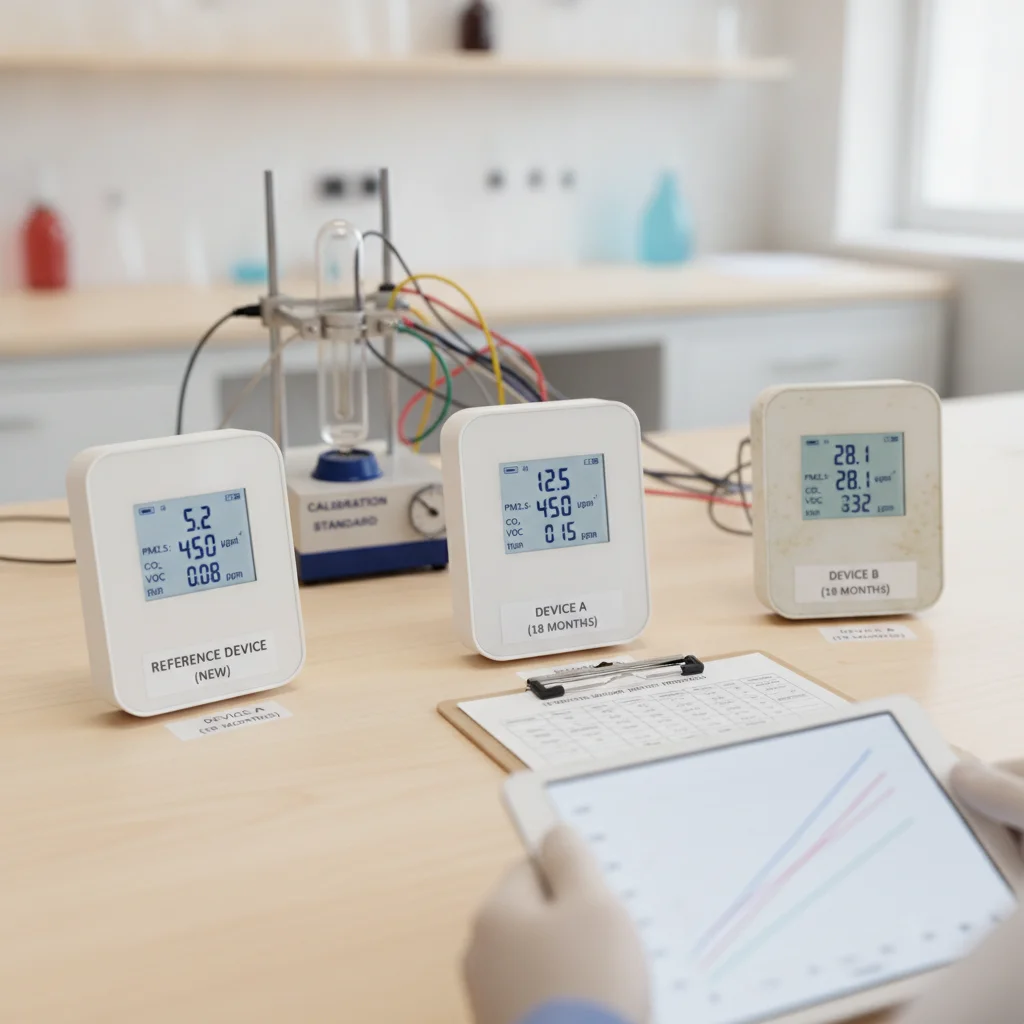
Most buying guides judge air quality monitors in the first weeks after unboxing. This long-term review tracks air quality monitor calibration drift long term across IQAir, PurpleAir, Awair, and uHoo so you can see which sensors still match reference gear after 18 months of real home use—not just day-one demos.
We cared about decision usefulness: when to run a purifier, when to open a window, and when a wildfire day is actually worse indoors than the app score suggests. Pretty dashboards matter less than whether PM2.5, VOC, and CO2 channels still tell a coherent story next to better equipment.
This is practical ownership guidance, not a medical diagnosis tool. People with asthma, allergies, or other respiratory conditions should treat monitor data as one input alongside clinician advice—not a substitute for care. For day-one accuracy shopping context, see our best air quality monitors 2026 roundup and the head-to-head IQAir vs PurpleAir vs Awair vs uHoo comparison.
- Horizon: baseline plus checks at 6, 12, and 18 months
- Sensors: PM2.5, VOC/TVOC proxies, and CO2 where the model includes them
- Setting: lived-in rooms, not sealed lab chambers only
- Bar: agreement with reference-grade trends, not marketing AQI colors
Monitors tested and baseline accuracy
The fleet covered a premium accuracy-leaning monitor (IQAir AirVisual-class), a dual-laser community PM specialist (PurpleAir PA-II-class), and two consumer multi-gas boards (Awair Element-class and uHoo-class). Fresh out of the box, all four produced usable indoor trends for smoke, cooking, and stuffy-room events.
Baseline week one is the easy part. Every serious competitor can look sharp when optics are clean and VOC chips have not yet absorbed months of cleaning sprays, cooking oils, and humidity swings. The question buyers actually ask after spending $150–$300 is whether month 18 still supports the same decisions.
- IQAir: strong early PM agreement; CO2 present depending on SKU
- PurpleAir: dual PM sensors with transparent raw channels; outdoor-capable heritage
- Awair: consumer UX with PM, VOC, CO2, and humidity in one compact body
- uHoo: broader gas suite; VOC/chemistry channels do more of the “health story” marketing
Reference equipment and calibration checkpoints
We collocated consumer units with reference-leaning PM and CO2 instruments during calm periods and during scripted events (toast smoke, closed-door CO2 buildup, cleaning-product VOC spikes). Checkpoints were logged at roughly 6, 12, and 18 months without factory returns unless a unit failed outright.
Reference gear is not “truth for your house forever,” but it is a better yardstick than comparing one consumer brand to another. We looked at bias and responsiveness: does the monitor rise when particles rise, and does it settle when the room clears?
- Confirm side-by-side placement height and orientation.
- Log a calm-period baseline against reference averages.
- Run short pollution events and note peak timing.
- Repeat the same protocol at each checkpoint.
What we measured at 6, 12, and 18 months
At six months, most PM channels still tracked events well. VOC baselines were already the noisier story on multi-gas consumer boards. By twelve months, humidity swings and at least one regional smoke week had widened gaps. At eighteen months, the ranking was clearer: optical PM durability beat metal-oxide VOC stability, with CO2 depending heavily on whether rooms still saw outdoor air exchange for auto-baseline routines.
After 18 months, PM2.5 laser sensors usually hold usable accuracy longer than metal-oxide VOC sensors, which often show the earliest baseline drift in consumer monitors. That single pattern explains more ownership frustration than any app redesign.
| Checkpoint | PM2.5 trend | VOC trend | CO2 trend |
|---|---|---|---|
| 6 months | Generally tight to reference events | Early baseline creep on some boards | Stable if ventilated nights occur |
| 12 months | Good on cleaner placements; early fouling after smoke | More false “elevated” plateaus | Soft high bias in sealed bedrooms |
| 18 months | Still decision-useful on top units | Least trustworthy without resets/replacement | Mixed; ventilation history matters |
PM2.5 Sensor Drift: When Particulate Readings Diverge
Particulate sensors are why many people buy these devices—especially in wildfire regions. Laser/optical counters estimate particle concentration from scattered light. Dust films, insect debris, and heavy smoke loading change that optical path over time.
PM drift is usually gradual, not a sudden cliff. That makes it dangerous: you can keep trusting a familiar number while the bias grows. Cross-checks against outdoor community sensors and your own smoke-day intuition matter more after year one.
Month-by-month PM2.5 accuracy vs reference
Through month six, IQAir and PurpleAir stayed closest to reference event shapes in our homes. Awair and uHoo still caught cooking and candle spikes, but absolute levels wandered more during mixed humidity weeks.
By month twelve, PurpleAir’s dual-sensor design made internal disagreement a useful self-check: when channels diverged after a dusty season, we cleaned inlets and re-checked. IQAir remained the steadier “single trustworthy indoor PM” experience for non-tinkerers. Consumer multi-gas units remained directionally helpful but needed more humility on exact µg/m³ claims.
At eighteen months, clean indoor placements with occasional window exchange still produced decision-useful PM on the stronger optical designs. Units that sat near kitchens or never saw a vacuumed shelf showed earlier positive bias and slower recovery after spikes.
- Best long-term PM confidence: IQAir and PurpleAir class units in our set
- Still useful with caveats: Awair/uHoo for “something changed” alerts
- Do not treat as lab: any consumer PM reading after heavy smoke weeks without a clean/check
Which models drifted fastest in dusty or smoky conditions
Smoke is a stress test. Fine particles load optical chambers; sticky residues remain after outdoor AQI drops. Homes that ran monitors through multiple wildfire weeks without inlet care saw earlier divergence—especially on units never designed as outdoor community nodes.
PurpleAir handled particle-heavy periods with more transparency because you can inspect dual channels and community correction practices. That does not mean the hardware is immortal. Fouled optics still need physical care. IQAir held indoor usefulness well when kept away from grease plumes. Awair and uHoo remained handy for alerts but were quicker to look “chronically elevated” after repeated smoke plus indoor dust.
If your priority is smoke response rather than multi-gas storytelling, start with the dedicated guidance in best air quality monitor for wildfire smoke and then plan for seasonal cleaning—not just a one-time purchase.
Early warning signs before readings become unreliable
Watch for patterns, not single weird minutes. Sensors glitch; drift is a lasting personality change.
- Calm outdoor days but indoor PM stuck high with windows open and no local source.
- Peaks that rise fast but take far longer to fall than they used to after the same cooking event.
- Growing disagreement with a collocated second monitor or a nearby trusted outdoor station trend.
- If your indoor monitor and a collocated reference disagree by more than about 20–30% on PM2.5 during calm periods, treat recalibration or replacement as overdue rather than trusting the prettier app score.
Allergy-focused buyers should also remember that PM is only one trigger pathway. Pair long-term sensor trust with the practical setup notes in best air quality monitor for allergies and asthma.
VOC and CO2 Calibration: The Hidden Drift Problem
Multi-gas consumer monitors sell peace of mind with VOC and CO2 tiles. Those channels age differently from PM. If you bought a monitor mainly for “chemicals in the air,” long-term calibration behavior matters as much as the unboxing video.
VOC sensor saturation and baseline drift
Most affordable VOC sensing uses metal-oxide or similar broad-response chips. They do not identify individual chemicals the way a lab GC-MS would. They respond to a cloud of compounds—and to humidity—then map that response to a colorful score.
Over months, baselines creep. Cleaning products, new furniture off-gassing, and cooking oils can leave the sensor “trained” into a higher normal. Firmware learning routines try to compensate, which can hide real pollution or invent chronic elevation. In our 18-month window, VOC was the first channel to lose trust on Awair- and uHoo-class boards.
- Short outdoor-air resets sometimes helped for a few days.
- Persistent high baselines after airing out usually meant the VOC story was done.
- Use VOC as a relative spike detector early in life; do not build multi-year health claims on it.
VOC tip: if every evening looks “unhealthy” with no new sources and open windows do nothing, suspect sensor baseline drift before you gut renovations.
CO2 NDIR drift in sealed vs ventilated rooms
NDIR CO2 cells are more physically grounded than VOC scores, which is why they remain useful for stuffy-bedroom decisions. They still drift, and many consumer devices lean on automatic baseline calibration that assumes the sensor periodically sees outdoor-ish air.
Consumer CO2 NDIR cells can stay within a useful band for home decisions at 18 months if auto-baseline routines run in rooms that still see outdoor air exchange. In tightly sealed bedrooms with poor night ventilation, we saw soft high bias more often: the algorithm “learns” a stale floor as normal or fails to find a true low.
Practical fix: periodically give the monitor a ventilated stretch near an open window on a clean outdoor day, follow manufacturer baseline instructions, and compare overnight bedroom peaks against your own comfort and window habits—not against marketing “ideal” alone.
When manufacturer recalibration guidance matches reality
Some brands offer field calibration, factory service, or honest “replace the module” paths. Others bury the topic because the business model assumes you buy another glossy box in two years.
In practice:
- PM-focused units with cleanable inlets and transparent data (PurpleAir class) reward maintenance more than mystical recalibration menus.
- IQAir-class indoor monitors stayed useful longer on PM without user tweaking; still verify after rough smoke seasons rather than assuming two-year immortality.
- VOC-heavy consumer boards often have no true user recalibration that restores a saturated sensor—replacement is the honest answer.
- CO2 responds best to correct placement and occasional outdoor-air baseline opportunities.
If you automate purifiers from these readings, unstable VOC baselines can create nuisance cycles. Keep automations on the more stable channels and read best smart home air quality monitor before wiring closed-loop control to a drifting gas score.
Environmental Factors That Accelerate Sensor Degradation
Two identical SKUs can age differently. Placement and climate explain more of that gap than firmware version notes.
High humidity and temperature swings
Humidity confuses VOC metal-oxide responses and can fog optical paths when condensation risk is real. Large day-night temperature swings near exterior walls add noise. Closets, bathrooms, and window sills look convenient and age sensors faster.
Keep monitors in conditioned living space, away from humidifiers and showers. If your climate runs humid summers, expect VOC scores to look “worse” seasonally even when your habits did not change—another reason not to treat VOC tiles as a multi-year absolute scale.
- Avoid exterior walls and sunny windowsills
- Avoid kitchens if grease film is visible on nearby shelves
- Avoid the floor; dust loading accelerates
- Prefer breathable shelf height in the room you actually occupy
Wildfire smoke events and particle loading
Smoke weeks are when you need the monitor most—and when you punish it hardest. Continuous high particle loading coats optics. After the plume passes, a fouled sensor may keep reading elevated or respond sluggishly.
Plan a post-smoke maintenance ritual: gentle inlet cleaning per manufacturer guidance, visual inspection, and a calm-day comparison against a secondary source. Skipping that ritual is how 12-month units start acting like 24-month units.
Monitors help most when they drive action—filtration, sealing, and verifying rooms clear. Ownership habits that turn readings into cleaner air are covered in air quality monitors that help reduce indoor pollutants.
Placement mistakes that shorten sensor life
We repeatedly saw avoidable damage patterns:
- Directly above the stove or next to the toaster oven.
- Inside a closed cabinet “to hide the gadget.”
- On the floor behind furniture where vacuum dust clouds hit daily.
- In a child’s room with constant essential-oil diffusers saturating VOC chips.
Good placement will not stop physics, but it delays the day your expensive monitor becomes a colorful random number generator.
18-Month Verdict: Which Monitors Hold Accuracy Longest
If you want one sentence: buy for the sensor you will still trust next year, not the app animation you like this week. In our 18-month set, PM-first designs aged more gracefully than VOC-marketing multi-gas boards.
| Monitor class | 18-month PM trust | VOC trust | CO2 trust | Best for |
|---|---|---|---|---|
| IQAir-class | High | Limited / N/A by SKU | Good with ventilation | Indoor accuracy without tinkering |
| PurpleAir-class | High (with care) | N/A focus | N/A on classic PM units | Smoke, transparency, dual-sensor checks |
| Awair-class | Medium | Low–medium by month 18 | Medium | Early multi-signal UX; verify later |
| uHoo-class | Medium | Lowest long-term confidence | Medium | Broad gas curiosity; expect channel attrition |
Best long-term accuracy by brand and sensor type
For long-term PM decisions, IQAir and PurpleAir remained the stronger pair. PurpleAir rewards owners willing to inspect dual channels and clean after harsh seasons. IQAir rewards owners who want fewer knobs and steadier indoor PM storytelling.
Awair still earns a place if you value a simple household dashboard and accept that VOC tiles may become advisory-only after a year-plus. uHoo’s broader chemistry story is interesting early and the first to need skepticism later. Neither multi-gas board beat the PM specialists on particulate durability in our homes.
When to replace vs recalibrate
Replace when:
- VOC baselines stay high after airing out and any official reset path
- PM disagrees badly with reference or a second unit on calm days after cleaning
- The manufacturer has no service path and support shrugs at drift
Attempt recalibration / baseline refresh when:
- CO2 looks chronically high in a room that can be ventilated
- The manual documents a field calibration or outdoor-air baseline procedure
- Only one channel failed while others still track events cleanly
Budget for the real ownership curve: a $200 monitor that needs replacement at month 20 is a different product from a $250 monitor that still guides purifier use at month 30.
Practical maintenance schedule for multi-year ownership
A light schedule beats heroic annual deep cleans you will skip.
- Monthly: wipe exterior, confirm vents are unobstructed, glance at calm-day readings.
- After each major smoke week: inlet care + sanity check vs a second source.
- Every 6 months: formal checkpoint against reference, a trusted outdoor trend, or a collocated loaner.
- Every 12–18 months: decide channel-by-channel—keep, baseline, or replace.
Write the install month on a label. Memory is a bad calibration log.
Frequently Asked Questions
Do air quality monitors lose accuracy over time?
Yes. Optical PM sensors usually drift more slowly than metal-oxide VOC sensors, while CO2 NDIR cells sit in the middle. After 12–18 months of real home use, expect some sensors to still support decisions and others to need recalibration, a factory service path, or replacement.
When should I recalibrate an air quality monitor?
Recheck when calm-period PM2.5 diverges roughly 20–30% from a collocated reference or trusted outdoor station trend, when VOC baselines climb with no new sources, or when CO2 stays high overnight in a ventilated room. Follow the manufacturer path if one exists; otherwise replace the unit or sensor module.
Does IQAir need calibration after 2 years?
IQAir’s consumer monitors are not designed like lab instruments you tweak weekly. In our 18-month window, its PM pathway stayed among the more stable units, but multi-year ownership still benefits from periodic reference checks—especially after heavy smoke seasons—rather than assuming factory accuracy forever.
How fast do PurpleAir sensors degrade?
PurpleAir’s dual Plantower-style PM sensors held useful agreement with reference trends longer than most VOC-heavy consumer boards in our set, though dusty or smoky placements accelerated divergence. Community correction factors help mapping; they do not erase physical fouling of the optical path.
Can I fix VOC sensor drift at home?
Usually only partially. Many VOC chips rely on soft baselines and “learning” routines that cannot restore a saturated sensing layer. Fresh outdoor air exposure and firmware resets sometimes help short-term, but persistent high baselines after cleaning and airing out often mean the VOC channel is no longer trustworthy.
Your Next Step
Choose the monitor whose strongest sensor still matches how you make decisions 18 months from now. If PM and smoke drive your purchases, favor IQAir- or PurpleAir-class durability and plan cleaning after bad air weeks. If you mainly wanted VOC theater, budget for earlier skepticism—or a replacement cycle.
Verify placement, log a six-month sanity check, and keep automations tied to the stabler channels. Long-term calibration drift is normal physics; pretending day-one accuracy lasts forever is how expensive gadgets quietly stop earning their shelf space.
Related reading on our sister sites: Mill Food Recycler Review After · Smart Ring After Months