Why Sticker Price Is Only Part of the Equation
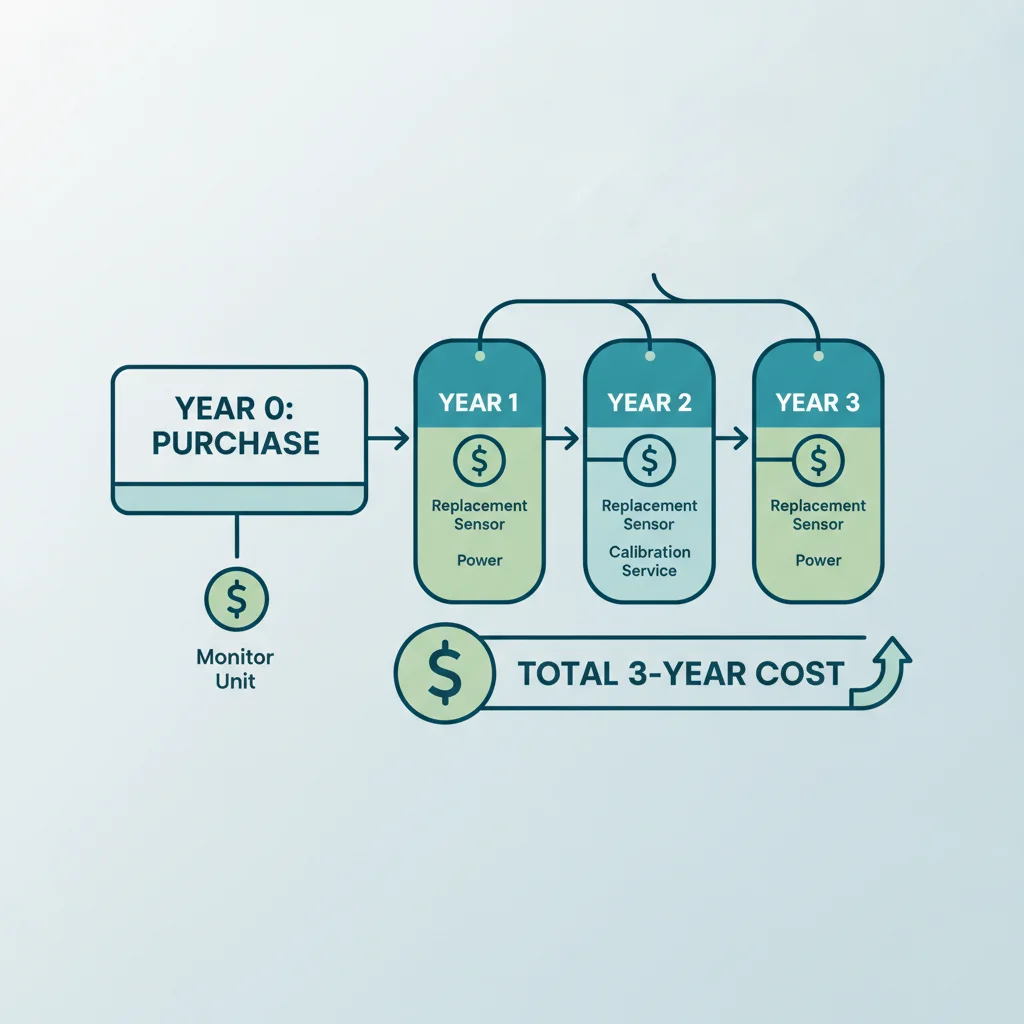
Shoppers comparing IQAir, PurpleAir, Awair, and uHoo often stop at the cart total. This guide maps air quality monitor total cost of ownership across three years—purchase price, replacement sensors, calibration paths, power, and optional cloud fees—so you can see what those “professional-grade” promises actually cost after the unboxing glow fades.
A $180 Amazon multi-gas unit can look thrifty next to a $300 accuracy-leaning monitor until you replace the cheap one every two seasons. The reverse is also true: a premium sealed unit with no consumer sensor kit can quietly become a full repurchase when VOC trust collapses.
This is ownership math for home decisions, not a medical device claim. People managing asthma, allergies, or smoke exposure should treat monitor data as one input alongside clinician advice. For day-one accuracy shopping, start with our best air quality monitors 2026 roundup and the head-to-head IQAir vs PurpleAir vs Awair vs uHoo comparison.
- Horizon: 36 months of normal home use
- Brands in focus: IQAir, PurpleAir, Awair, and uHoo class units
- Cost buckets: hardware, sensors/modules, calibration/service, power, optional subscriptions
- Decision bar: dollars spent per year of decision-useful readings—not marketing AQI colors
Hardware vs replacement sensor and calibration costs
Upfront hardware is the easy line item. Replacement PM boards, VOC modules, and factory recalibration are the ones product pages bury in FAQs—or omit entirely.
Over three years, replacement PM and VOC sensors plus occasional calibration often add 20–60% on top of the sticker price for premium consumer air quality monitors. Modular designs shift that spend into discrete parts; sealed designs shift it into another full unit.
- Modular PM: cheaper mid-life repairs when you can buy the board
- Sealed multi-gas: fewer SKUs to service; higher “replace everything” risk
- Calibration: rare for homes, expensive when you chase lab-grade certainty
What product pages leave out after year one
Most listings emphasize app dashboards, “lab-inspired” sensors, and protective-family language. Few show a 24-month VOC baseline, a smoke-season cleaning routine, or a price for the next Plantower-class board.
After year one you learn which channel you actually trust. Many households keep using PM for cooking and wildfire days while discounting VOC scores that never settle. That behavioral shift is an ownership cost too—you paid for sensors you no longer believe.
- Ask whether sensors are user-replaceable before you buy.
- Ask what “calibration” means: soft app reset versus factory service.
- Ask whether cloud history or alerts require a paid tier.
- Ask how warranty treats gradual drift versus hard failure.
How we tracked 36-month ownership spend
We built TCO from street prices for current consumer SKUs, published accessory/service ranges where brands sell them, typical always-on power at residential rates, and realistic replacement timing from long-term use patterns—not lab immortality claims.
Numbers below are planning bands for 2026 shopping, not invoices from one retailer. Currency, kits, and firmware change; treat the ranking logic as durable even when a SKU price moves $30.
| Cost bucket | What we included | What we excluded |
|---|---|---|
| Purchase | Typical street price for a mainstream home SKU | Bundle deals, open-box one-offs |
| Sensors / units | One mid-life module swap or one budget full replacement | Collector multi-room fleets |
| Calibration | DIY resets as free; factory path as optional premium | Reference-lab certification for workplaces |
| Power / cloud | Always-on Wi-Fi electricity + optional paid tiers | Whole-home hub ecosystems you already own |
Replacement Sensor Costs by Brand
Sensor architecture decides whether year-two spend is a spare part or another monitor. That single design choice explains more TCO variance than any app redesign.
IQAir and premium monitor sensor pricing
IQAir’s consumer monitors sell accuracy and polish more than hobbyist modularity. Owners usually cannot walk into an accessory aisle and buy a $40 PM cartridge the way they might for community-node hardware.
Does IQAir publish a neat “sensor replacement price” for every home SKU? Often no—so honest budgeting means planning careful placement, inlet hygiene after smoke weeks, and eventual full-unit replacement if channels stop matching reality. That is not a knock on day-one performance; it is the ownership shape of sealed premium gear.
- Typical purchase band: roughly mid–high hundreds depending on SKU and kit
- Mid-life parts: limited consumer modules; service/replace-unit mindset
- Best fit: households that want one trusted indoor PM/CO2 story and will keep the unit clean
If smoke response is your primary job-to-be-done, pair this TCO view with the dedicated notes in best air quality monitor for wildfire smoke before you pay for multi-gas extras you may not trust later.
Awair and uHoo cartridge and module costs
Awair Element-class and uHoo-class monitors win on consumer UX and multi-parameter dashboards. Their ownership risk is less “missing a $25 board” and more “the VOC tile becomes decorative while you still paid for the whole suite.”
When brands do not sell clean user-swappable gas cartridges at transparent prices, maintenance becomes soft resets, firmware learning, and eventual repurchase. uHoo historically marketed richer gas storytelling; richer chemistry also means more channels that can age unevenly.
- Awair-class: compact multi-sensor; plan for sealed-unit economics
- uHoo-class: broader gas suite; verify current accessory and subscription policy on the exact SKU
- Shared pattern: PM may outlast the “chemicals” narrative you bought
Budget monitors: replace the whole unit vs swap sensors
Budget sealed units can look cheapest at checkout and still lose on total cost of ownership if you replace the whole monitor every 18–24 months instead of swapping modules. Two $90 monitors plus shipping frustration can beat one $250 modular node—or lose to it—depending on whether you actually replace on schedule.
PurpleAir-class dual-sensor designs sit in a different lane: community mapping heritage and more transparent PM hardware culture. When Plantower-style boards are available as spare parts, a mid-life swap can keep the chassis online for a fraction of a new premium sealed monitor.
- Price the spare sensor before you celebrate a low cart total.
- Count how many full replacements you would tolerate in 36 months.
- Decide whether you need multi-gas theater or durable PM trends.
Calibration and Maintenance: What You Actually Pay
Calibration is the word brands use for everything from “open a window and let the baseline settle” to “ship us the unit.” Your wallet cares which definition you bought into.
Factory recalibration vs DIY baseline resets
DIY baselines—fresh outdoor air, firmware auto-ABC for CO2, calm-period cross-checks against a trusted outdoor station—cost time, not invoices. Factory or depot recalibration, when offered at all for consumer SKUs, is a premium path aimed at people who need documented accuracy.
Most homeowners never need a paid factory ticket if they accept decision-grade trends instead of lab certificates. Pay when you cannot tolerate a 20–30% calm-period PM disagreement with better gear and the manufacturer actually offers a service SKU.
- Free / DIY: ventilation resets, placement fixes, inlet cleaning
- Paid / rare: factory recalibration or replacement under service programs
- Reality check: many consumer VOC chips cannot be “recalibrated” back to new
Professional calibration service costs
Third-party environmental labs can verify instruments, but the fee often exceeds the remaining value of a mid-tier consumer monitor. That path makes sense for workplaces and research setups more than for a living-room dashboard.
For home TCO, treat professional calibration as an optional insurance purchase—not a default line item. If you find yourself shopping lab services for a $200 unit, replacing the monitor is usually the rational move.
Warranty coverage for sensor drift
Warranties love sudden death. Gradual drift is murkier. A unit that still powers on and phones home may be “working as designed” even when VOC baselines look chronically elevated.
Read the fine print for sensor exclusions, consumable language, and whether smoke-heavy use voids claims. Photograph unboxing baselines if you care; evidence helps more than vibes when you open a ticket at month 14.
- Confirm whether drift is covered or only hard failure.
- Confirm whether user-cleaned inlets are required.
- Confirm RMA shipping costs—those are ownership costs too.
Running Costs: Power, Connectivity, and App Subscriptions
Power draw is usually under $10 per year for always-on Wi-Fi monitors; sensor modules, factory recalibration, and optional cloud tiers are where the real ownership spend hides. Still, ignore electricity and you leave a real (if small) line off the spreadsheet.
Always-on Wi-Fi monitor power draw
Typical wall-wart monitors sip power compared with HVAC. At common residential rates, continuous operation over three years is usually a low two-digit dollar total—not the reason to skip a useful sensor.
Placement still matters: heat, grease, and bathrooms shorten sensor life faster than watts on the bill. A cooler shelf away from cooking plumes is free maintenance.
- Expect: always-on Wi-Fi + LED/display draw in the single-digit watts class for many models
- Budget: low annual electricity; do not over-weight it versus sensors
- Save more by: extending sensor life with cleaner air and less kitchen fog
Cloud features and optional subscription tiers
Some brands gate long history, advanced alerts, or export behind accounts or paid tiers. Others keep local or free-cloud basics usable without a monthly fee.
Subscriptions rarely dominate three-year TCO unless you stack multiple devices or buy features you never automate. If you will not drive a purifier or vent from the data, paid cloud is mostly a nicer chart.
- List which features work offline or on the free tier.
- Price three years of any required subscription before checkout.
- Prefer monitors that still alert usefully if the cloud hiccups.
Automation buyers should cross-check integration quality in best smart home air quality monitor—a $5/month tier cannot fix a brittle Home Assistant path.
Smart home hub requirements and hidden hardware
Matter, Thread, Bluetooth bridges, and hub dongles are easy to forget in TCO. If your “simple” monitor needs a $70 bridge you do not own, that bridge belongs on the first-year ledger.
Conversely, if you already run Home Assistant or a mature Alexa/HomeKit stack, incremental hub cost may be zero. Count only the hardware the monitor uniquely forces.
- Bridge / hub uniquely required by this monitor
- Extra indoor nodes if one unit cannot cover your layout
- Spare PM boards if you choose a modular fleet
Three-Year TCO Comparison: When Premium Monitors Pay Off
Put the buckets together and premium is not automatically more expensive—or automatically smarter. The break-even depends on replacement cadence and which channels you still trust in year three.
TCO bands by monitor category
Use these planning bands for a single primary home monitor over 36 months. They assume one mid-life intervention (module swap or budget full replace) and free DIY baselines—not annual lab tickets.
| Category | Typical purchase | Likely mid-life spend | 36-month TCO band | Ownership notes |
|---|---|---|---|---|
| Premium sealed (IQAir-class) | Higher sticker | Low parts; risk of full replace late | High single unit, moderate extras | Pays off if PM trust lasts and you avoid churn |
| Modular PM node (PurpleAir-class) | Mid sticker | Board swaps possible | Often best parts-led TCO for PM focus | Rewards DIY comfort |
| Consumer multi-gas (Awair/uHoo-class) | Mid sticker | Sealed economics; VOC aging | Mid–high if you repurchase for multi-gas hope | Great UX; budget honesty on VOC lifespan |
| Budget sealed Amazon-class | Low sticker | Full unit every 18–24 months common | Can meet or beat premium—or overshoot | Churn risk is the real cost |
Allergy-focused buyers should also price the workflow, not just the widget: see best air quality monitor for allergies and asthma for how readings turn into room habits.
Break-even vs replacing a budget unit every 2 years
Suppose a budget sealed monitor costs $100 and you replace it at month 20 and again near month 36. That is three chassis in the window before shipping and setup time. A $280 modular or premium unit with one inexpensive board swap can win even before you value fewer dead batteries in the drawer.
Flip the scenario: if the budget unit still gives decision-useful PM at month 36 and you never cared about VOC, TCO stays low. Honesty about what you will actually replace matters more than brand mythology.
- Write down your replacement tolerance (0, 1, or 2 full units).
- Price the spare part path if one exists.
- Subtract features you will ignore by month 18.
Which monitors are worth the ongoing investment
Premium monitors pay off when stable PM (and often CO2) still drive purifier and window decisions in year three, and when you would otherwise churn cheap sealed units. They are weaker when you mainly bought rainbow VOC tiles and optional subscriptions you never use.
PurpleAir-class ownership shines if you want transparent PM hardware culture and can handle a module mentality. Awair/uHoo-class ownership shines for day-to-day UX—just bank on multi-gas channels aging faster than the plastic shell.
If your goal is cleaner indoor air—not just prettier numbers—pair ownership planning with air quality monitors that help reduce indoor pollutants so the dollars buy actions, not only charts.
- Buy premium sealed for durable indoor PM trust and low DIY appetite
- Buy modular PM when spare boards and community transparency matter
- Buy consumer multi-gas for UX, with eyes open on VOC lifespan
- Buy budget sealed only if you accept churn or short-horizon experiments
Your Next Step
Price the three-year stack—hardware, mid-life parts or replacement, any paid cloud, and the hub you uniquely need—before the cart total tricks you. The cheapest monitor is the one that still earns trust when you need it, not the one with the lowest unboxing receipt.
Pick the architecture that matches how you maintain gear: sealed and careful, or modular and hands-on. Then spend the savings on the interventions the data should trigger—filtration, ventilation, and source control—not on another dashboard you will ignore by next wildfire season.
Frequently Asked Questions
What is the total cost of ownership for an air quality monitor?
Plan for purchase price plus three years of replacement sensors or full-unit replacements, any factory recalibration fees, electricity, and optional cloud subscriptions. For mainstream home models, honest 36-month TCO often lands roughly 1.2×–1.6× the sticker price—higher if you replace sealed budget units every couple of years.
How much do air quality monitor replacement sensors cost?
Modular PM boards (for example PurpleAir-class Plantower swaps) can be tens of dollars each when you DIY. Premium sealed monitors often have no consumer-priced sensor kit, so “replacement” means buying another unit. Always check whether the brand sells a user-serviceable module before assuming the sticker price is a one-time spend.
Does IQAir charge for sensor replacement?
Consumer IQAir monitors are typically treated as sealed accuracy-forward devices rather than hobbyist sensor kits. Owners usually budget for careful placement and eventual full-unit replacement or manufacturer service paths—not a cheap cartridge aisle SKU. Confirm current SKU policy before you buy, because accessory availability changes by model year.
How long do air quality monitors last?
Optical PM sensors in clean indoor placements often stay decision-useful for two to four years. Metal-oxide VOC channels degrade faster. Many households replace or heavily discount VOC trust by 18–24 months while still relying on PM and CO2 for daily decisions.
Are premium air quality monitors worth the higher ownership cost?
They can be, when you need stable PM trends for smoke or allergy decisions and you would otherwise churn through two budget units in three years. They are a weaker buy if you mainly want pretty multi-gas scores, because VOC channels still age and optional subscriptions add little if you never automate a purifier.
Related reading on our sister sites: Electric Composter Total Cost Ownership · Best Standing Desk for Programmers