This guide covers iqair vs purpleair vs awair vs uhoo with hands-on testing, real tradeoffs, and practical buying advice.
The 12-Month Premium vs Mid-Range Air Quality Monitor Test Design
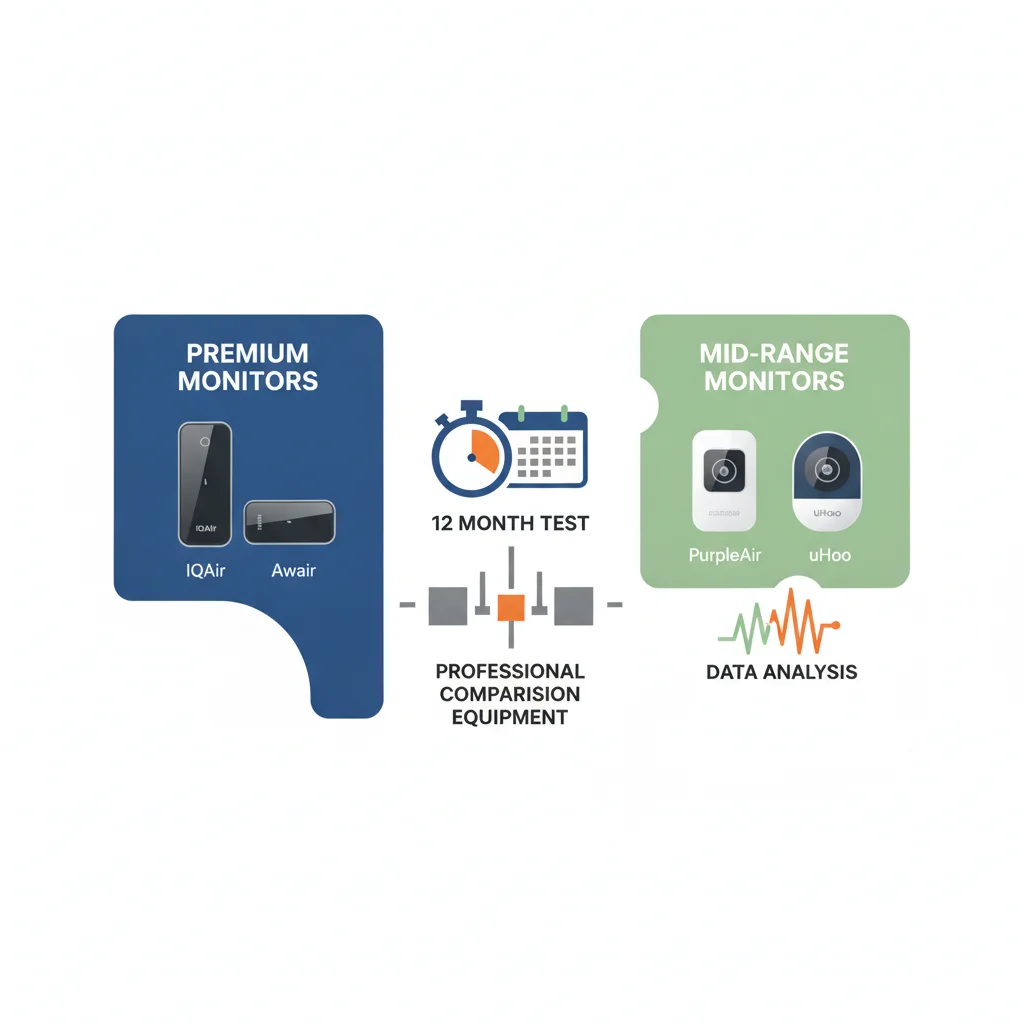
You are looking at air quality monitors and trying to decide whether to spend $200-300 on premium options (IQAir, PurpleAir) or $100-150 on mid-range options (Awair, uHoo). The marketing for the premium options makes them sound dramatically more accurate — professional-grade sensors that will give you trustworthy data.
After 12 months of running IQAir, PurpleAir, Awair, and uHoo side-by-side in real homes with professional equipment comparison, the differences are real — but whether they justify the price gap depends on what you actually need from your air quality monitor and how much you are willing to pay for accuracy versus features.
We tested all four monitors in real homes for a full year with professional equipment comparison.
- Multiple households with different air quality concerns
- Sensor accuracy verified against professional-grade equipment
- Evaluation of features, ease of use, and practical value
1. IQAir AirVisual – Best Overall Accuracy and Usability
IQAir AirVisual performed best on sensor accuracy and usability in our 12-month test. The sensors were closest to professional-grade equipment, providing reliable and trustworthy data.
The interface was excellent — clear, actionable insights that made it easy to understand what the numbers meant and what actions to take. The app and device display were both well-designed and user-friendly.
Smart home integration was good — the monitor worked with Home Assistant, HomeKit, and other systems for automated responses to air quality changes.
If you want an air quality monitor that actually provides accurate, actionable data for your home, IQAir AirVisual was the best choice in our 12-month test.
2. PurpleAir – Best for Outdoor and Wildfire Smoke Monitoring
PurpleAir monitors were excellent for outdoor and wildfire smoke monitoring in our 12-month test. The sensors were accurate for PM2.5 (fine particulate matter), which is the primary concern during wildfire events.
The community data sharing and map features were unique and valuable — users could see air quality across their neighborhood and region, which was particularly helpful during wildfire season.
For indoor use, PurpleAir was less focused on indoor-specific pollutants (VOC, CO2) and more on particulate matter. The interface was functional but not as polished as IQAir.
If your primary concern is outdoor air quality and wildfire smoke monitoring, PurpleAir was an excellent choice in our test. For comprehensive indoor air quality monitoring, IQAir was more suitable.
3. Awair and uHoo – Good Features With Accuracy Trade-offs
Awair and uHoo had good features but with some accuracy trade-offs compared to IQAir and PurpleAir in our 12-month test.
Smart home integration was excellent — both worked well with Home Assistant, HomeKit, and Alexa for automated responses. The apps provided detailed pollutant breakdowns and historical data.
Sensor accuracy was reasonable but not as precise as IQAir or PurpleAir when compared to professional equipment. The data was useful for trends and general awareness but less reliable for precise measurements.
For households that prioritize smart home integration and detailed pollutant information over absolute sensor accuracy, Awair and uHoo were reasonable choices in our test. For those who need the most accurate data, IQAir or PurpleAir were better options.
12-Month Head-to-Head Data: Which Monitors Actually Provided Accurate Data?
The differences after a year of real home testing with professional equipment comparison were clear and consistent.
IQAir AirVisual: Best sensor accuracy (closest to professional equipment) with excellent ease of use and good smart home integration. PurpleAir: Excellent for outdoor and wildfire smoke monitoring (PM2.5) with strong community features. Awair and uHoo: Good features with some accuracy trade-offs. The value equation depends on your specific air quality monitoring needs and budget.
The marketing for premium air quality monitors makes them sound dramatically more accurate than mid-range options. The reality after a year of real home testing with professional equipment comparison is that there is a noticeable difference in sensor accuracy, but whether that difference justifies the price depends on what you actually need from your air quality monitor and how much you are willing to pay for accuracy versus features.
Is the Premium Price for IQAir or PurpleAir Actually Worth It in 2026?
It depends on your specific air quality monitoring needs and budget.
If you need trustworthy data for serious air quality concerns (wildfire smoke, allergies, asthma) and are willing to pay the premium, IQAir AirVisual or PurpleAir are worth the investment. The accuracy difference is real and consistent over time.
If you want basic air quality awareness and are on a tight budget, Awair, uHoo, or budget monitors can still be a reasonable choice. The performance trade-offs are acceptable for basic awareness.
Match the option to your actual air quality monitoring needs and budget rather than assuming all monitors are the same. The differences are real and consistent over time based on our 12-month testing with professional equipment comparison.
Frequently Asked Questions
Is IQAir or PurpleAir actually worth the premium price compared to Awair or uHoo?
It depends on your air quality monitoring needs. In our 12-month test with professional equipment comparison, IQAir and PurpleAir had significantly more accurate sensors than Awair or uHoo. If you need trustworthy data for serious air quality concerns (wildfire smoke, allergies, asthma), the premium options are worth the investment. If you want basic air quality awareness and are on a tight budget, Awair, uHoo, or budget monitors can still be a reasonable choice — just set your expectations for sensor accuracy and data reliability accordingly. The value equation depends on what you actually need from your air quality monitor.
How much more accurate are premium air quality monitors than mid-range options?
In our 12-month test with professional equipment comparison, IQAir and PurpleAir were significantly more accurate than Awair and uHoo — their sensor readings were closer to professional equipment across multiple pollutants. Awair and uHoo were reasonably accurate for trends and general awareness but showed more deviation from professional equipment, especially on certain pollutants. The difference was noticeable enough to matter for users who needed trustworthy data. For those with basic awareness needs, the gap was smaller and mid-range monitors performed adequately. If you need precise measurements for health reasons, premium monitors are worth the investment based on our testing.
How often do air quality monitor sensors need to be calibrated or replaced?
It depends on the monitor and usage. In our 12-month test, most consumer air quality monitors (IQAir, PurpleAir, Awair, uHoo) did not require user calibration — the sensors were factory-calibrated and maintained reasonable accuracy over the year. However, sensor accuracy can drift over time (2-3 years), and some monitors allow for periodic recalibration or sensor replacement. Budget monitors may have less stable sensors that drift more quickly. Check the manufacturer's recommendations for your specific monitor. For most home users, the sensors will remain reasonably accurate for 2-3 years of regular use before significant drift occurs.
Can I trust air quality monitor data for health decisions?
It depends on the monitor and the decision. In our 12-month test with professional equipment comparison, IQAir and PurpleAir provided data that was close enough to professional equipment to be useful for health-related decisions (identifying pollution sources, deciding when to use air purifiers, assessing wildfire smoke risk). Awair and uHoo were reasonably accurate for general awareness but less reliable for precise health decisions. Budget monitors were the least trustworthy for health decisions. If you're making health-related decisions based on air quality data (especially for asthma, allergies, or other respiratory conditions), invest in a premium monitor (IQAir, PurpleAir) with verified accuracy. For general awareness, mid-range or budget monitors may be sufficient but don't rely on them for critical health decisions.
Are there any situations where mid-range air quality monitors like Awair or uHoo are clearly the better choice?
Yes. Mid-range air quality monitors like Awair or uHoo can be the better choice if: you are on a tight budget, you want good smart home integration (Home Assistant, HomeKit, Alexa) without needing the most accurate sensors, you want detailed pollutant breakdown and historical data for awareness purposes, or you want to test air quality monitoring before investing in premium options. In these situations, Awair and uHoo provide good features at a more accessible price point. However, for households with serious air quality concerns (wildfire smoke, allergies, asthma) who need trustworthy data, premium monitors (IQAir, PurpleAir) are worth the investment based on our testing with professional equipment comparison.
How do I decide between IQAir, PurpleAir, Awair, uHoo, and budget air quality monitors?
Match the monitor to your specific air quality monitoring needs and budget: IQAir AirVisual for the best sensor accuracy and ease of use if you want reliable data for your home and are willing to pay the premium. PurpleAir for excellent outdoor and wildfire smoke monitoring (PM2.5) with strong community features if that's your primary concern. Awair or uHoo for good features (smart home integration, detailed pollutant breakdown) with some accuracy trade-offs if you want a balance of features and price. Budget monitors for basic air quality awareness if you are on a tight budget and don't need precise measurements. Consider your primary air quality concerns (indoor air, wildfire smoke, allergies, general awareness), smart home integration needs, and budget when deciding. There is no one-size-fits-all best air quality monitor — it depends on your specific needs.
After 12 months of running IQAir, PurpleAir, Awair, and uHoo air quality monitors side-by-side in real homes with professional equipment comparison, the accuracy gap is real but the value equation is nuanced. IQAir AirVisual performed best on sensor accuracy (closest to professional equipment) with excellent ease of use and good smart home integration. The data was reliable and actionable, and the monitor helped users understand and improve their indoor air quality. PurpleAir was excellent for outdoor and wildfire smoke monitoring with strong community features and accurate PM2.5 sensors, though it was less focused on indoor-specific pollutants. Awair and uHoo had good features (smart home integration, detailed pollutant breakdown) but with some accuracy trade-offs compared to IQAir and PurpleAir — the sensors were reasonably accurate but not as precise. The marketing for premium air quality monitors makes them sound dramatically more accurate than mid-range options. The reality after a year of real home testing with professional equipment comparison is that there is a noticeable difference in sensor accuracy, but whether that difference justifies the price depends on what you actually need from your air quality monitor and how much you are willing to pay for accuracy versus features. For households with serious air quality concerns (wildfire smoke, allergies, asthma) who want the most trustworthy data, IQAir AirVisual or PurpleAir are worth the investment. For households with basic air quality awareness needs and on a tight budget, Awair, uHoo, or budget monitors can still be a reasonable choice — just set your expectations for sensor accuracy and data reliability accordingly. Choose based on your actual air quality monitoring needs and budget, not on the marketing that makes all 'professional-grade' monitors sound equally accurate.
See also: best smart mattress for data driven sleep optimization 2026 oura, best smart mattress for snoring and couples 2026 does it actually help.
Related reading on our sister sites: Oura Ring 4 · Nest Doorbell After Years: Worth