The best indoor garden for vegetables is the kit whose lamp still sits a few inches above a dwarf tomato when the flowers open: AeroGarden Bounty’s 24-inch grow height plus a 6-inch trellis, or a Gardyn column that never puts a roof over the canopy. Harvest’s 12-inch bar and Click & Grow Smart Garden 3’s 470 mm lamp cage are herb appliances that also sell mini-tomato pods.
This guide uses the current US listings from Scotts Miracle-Gro’s AeroGarden size table, the Bounty product page, the Harvest product page, Scotts’ indoor tomato and pepper grow notes, Click & Grow Smart Garden 3, the brand’s Mini Tomato pods and staking timeline, Gardyn’s Home vs Studio shop table, Gardyn’s cherry tomato and cucumber yCubes, the sweet-pepper plant book and care-cycle article, plus WIRED’s 2026 indoor-garden gallery. Herb-kit geometry sits on the published AeroGarden vs Click & Grow vs Gardyn comparison; category ranking for mixed salad kits sits on the smart indoor garden 2026 hub.
Buy AeroGarden Bounty if you will give a 17.25-by-11.25-inch table a 34-inch lamp, leave empty pods around the fruiting plants, and shake flowers yourself. Buy Gardyn Studio 2 or Home 4 if the crop is vines and peppers that need a high-light column with no roof. Skip Harvest and Smart Garden 3 if the job is salsa tomatoes rather than basil; both still sell compact fruit pods, but the cages are built for garnish height.
Grow height is the filter, not the logo on the bowl
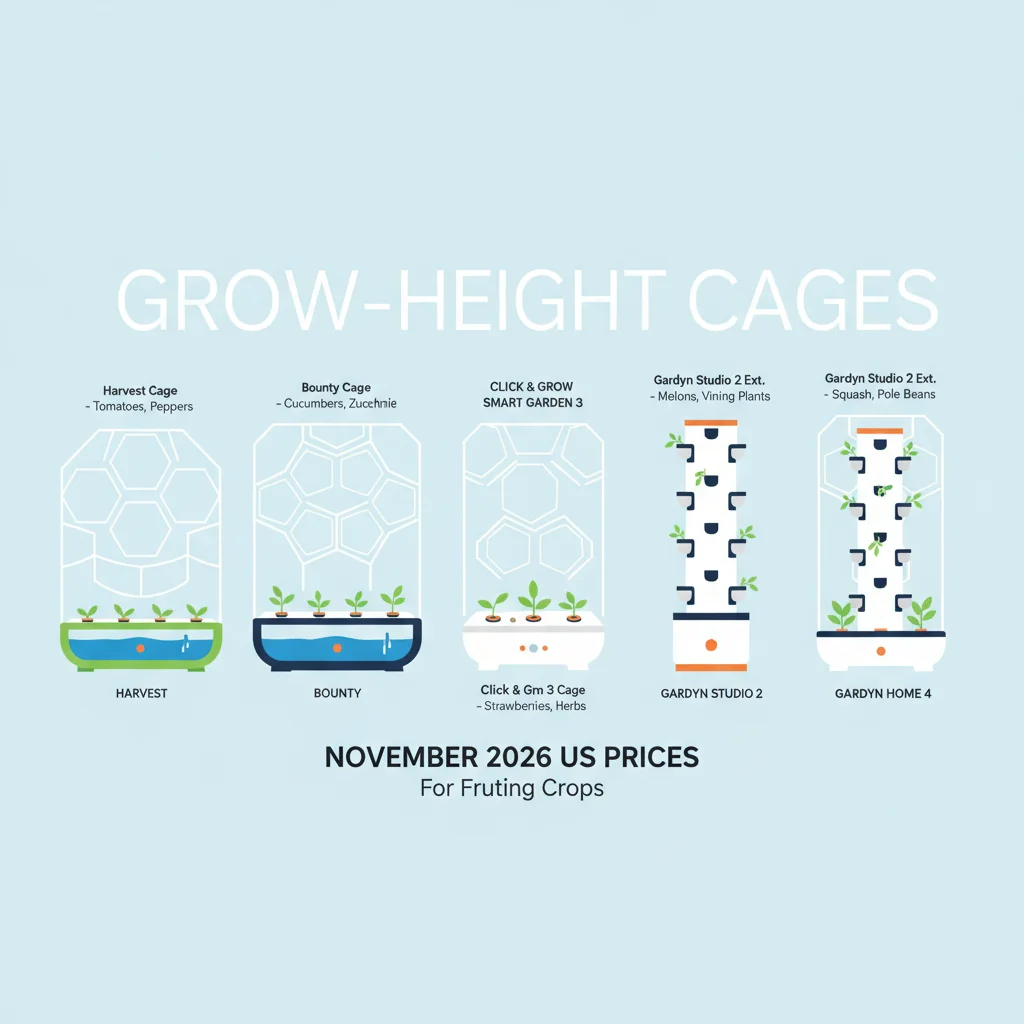
Scotts’ indoor-garden size table on the AeroGarden gardens hub is the shortest honest buying rule. Sprout is listed at 6 inches of grow height for herbs and compact plants. Harvest family is 12 inches for herbs, lettuce, and “small fruiting plants.” Bounty family is 24 inches for tomatoes, peppers, and larger harvests. Farm 12XL is the 12-pod floor unit Scotts points at “maximum yield”; the dedicated Farm 12XL SKU URL redirected to that same category listing when checked on 3 November 2026, so treat Farm as a listed family, not a guaranteed cart button today.
On the same hub, Scotts tells you to skip every other hole when you run fruiting plants, and to pick Bounty or Farm 12XL for tomatoes and peppers because those crops want 24-plus inches. Lettuce is 3 to 4 weeks; herbs 4 to 6 weeks; tomatoes and peppers 8 to 12-plus weeks. Fruiting plants also get a faster full water change: every 2 to 3 weeks versus about 4 weeks for the rest of the lineup. That is manufacturer cadence, not a kitchen log.
Bounty’s own spec block matches the table: 9 pods, 40 W LED, 17.25 inches wide by 11.25 inches deep by 34 inches tall, grow height up to 24 inches, Wi-Fi, a color touchscreen, vacation mode, and a 6-inch attachable trellis in the box. Hardware showed $114.98, marked down from $229.95, and out of stock on 3 November 2026. Bounty Elite sat at $274.95 on the same day. The FAQ on that page names cherry tomatoes and peppers as the vegetable examples, not beefsteak vines.
Harvest’s spec block is the ceiling most countertop shoppers actually buy: 6 pods, 20 W LED, 10.5 by 6 by 17.4 inches, grow height up to 12 inches, no trellis in the carton. Sale price $76.97 from $109.95. The Harvest FAQ says you can run 6-pod kits that include “some compact vegetables.” Scotts still files tomatoes and peppers on the Bounty/Farm row of the size table, not on Harvest’s 12-inch row.
Scotts’ indoor-garden size table gives Bounty 24 inches of grow height for tomatoes and peppers, and Harvest only 12 inches.
Click & Grow Smart Garden 3 is a wick box, not a hydroponic bowl. The US store lists it at $124.95 with three sites, 300 mm width, 120 mm depth, lamp height 210 to 470 mm depending on the two extension arms, 8 W / 3.8 kWh per month. 470 mm is about 18.5 inches of whole appliance, lamp included. Mini Tomato pods are $14.95 and list 7–14 days to sprout and 14–18 weeks to harvest. The staking blog’s timeline puts yellow flowers around days 40–60, green fruit around 73–89, and ripe fruit around 90–110 days, then the plant degrades because the pod’s job is done. That is a determinate dwarf, not a grocery-replacement vine, and it still needs a chopstick when fruit gets heavy.
Gardyn’s shop comparison is the open-column alternative. Studio 2: 17 by 12 by 54 inches, 1.4 sq ft, 16 plants, one 52 W bar, 26 kWh per month, $549. Home 4: 24 by 12 by 64 inches, 2.0 sq ft, 30 plants, two 40 W bars, 47 kWh per month, $899. Lights sit on the front of the pipes. There is no telescoping hood that tomatoes grow into. Manufacturer yield copy is “up to 5 lbs” a month on Studio and “up to 10 lbs” on Home; those ceilings are salad-weight marketing, not a weighed tomato log.
WIRED’s fruiting notes, quoted as someone else’s garden
WIRED’s September 2026 gallery is the independent write-up this page leans on for how those cages behave with fruit, not a substitute for a Smart Living IQ grow. Bounty’s cage trellis is described as the part that corrals “wayward herbs or vegetables.” A Salsa Garden kit of six tomato pods and three jalapeños produced hardy tomatoes that then buried the peppers. LetPot’s 16-inch top lamp is called too short for tomatoes, peppers, or other fruiting plants. Rise Garden 3’s tomatoes were “notably bigger and better tasting” than the ones in other systems in that test, with a heat penalty for herbs and lettuce. Gardyn Home 4 grew kohlrabi and a whole cauliflower; a cucumber from a Gardyn Studio was, in that reviewer’s words, one of the best they had eaten. Fruiting crops were slower than greens, and strawberries needed a paintbrush on the flowers each morning.
WIRED’s 2026 indoor-garden gallery found LetPot’s 16-inch lamp too short for tomatoes and peppers, while Bounty’s cage trellis is meant to corral fruiting stems.
Those are Kat Merck’s 2026 notes. They do not become our harvest weights. They do line up with the manufacturer geometry: a 12- or 16-inch hood is a greens machine; a 24-inch Bounty or an open Gardyn/Rise column is where fruiting is even in the conversation.
Countertop bowls that can fruit, and the ones that only tease it
Bounty is the countertop that Scotts actually assigns to tomatoes. The grow-notes article is blunt: more light means more tomatoes, indoor fruiting is fussy, and you should plan on about 90 days to a first harvest, sometimes more. Flowers often show around day 30 in hydroponic setups, then fruit needs another month to size and another month to color. Self-pollinating tomato and pepper flowers still need a shake or a fan because there is no wind indoors. Empty reservoirs kill plants overnight once the canopy is large. Full nutrient changes every two weeks are the tomato rule on that page, tighter than the generic AeroGarden monthly dump.
Spacing is the other Bounty constraint. Nine holes does not mean nine tomato plants. Scotts’ hub says use every other spot for fruiting plants. WIRED’s salsa kit is the object lesson: six tomatoes plus three jalapeños in one hood is a crowding experiment, and the early germinators won. A useful Bounty salsa layout is two or three tomato sites, one or two peppers, and the rest empty or basil you will prune hard. The 6-inch trellis is in the carton because fruit leans; it is not optional décor.
Owner copy on the Bounty page is mixed in the useful way. A 21 October 2026 review signed Sandy2026 says that writer grew mini tomatoes, basil, romaine, and arugula and liked the water and food reminders. Other recent reviews on the same URL are herb-only. That is one dated owner note, not a yield study. Hardware stock was empty on the check date, so a Bounty plan is a restock watch at the sale number, or Elite at $274.95 if that SKU is the one on the shelf.
Harvest will germinate a compact vegetable kit. It will not grow you out of the 12-inch rule. Keep the bar a few inches above the canopy, which means a stretching tomato hits the LEDs and you prune or you scorch. There is no trellis in the Harvest carton. If the only free slot in the kitchen is a 17-inch-tall under-cabinet strip, Harvest is the herb bowl; the vegetable job belongs on a table that can take Bounty’s 34 inches, or on the floor.
Click & Grow’s Mini Tomato is the honest small-fruit SKU for a wick garden. Thin to one seedling. Stake around days 22–39. Pollinate the yellow flowers. Expect ripe fruit in the 90–110 day window on the staking blog, and then a plant that is done. Do not prune the top before fruit, because flowers sit there. Smart Garden 3 still only has three cups and an 8 W lamp. A $14.95 three-pack is a garnish tomato, not a sandwich supply. Click & Grow’s pod page also repeats a “2.5x more antioxidative activity than store-bought tomatoes” line; that is brand copy on that URL, not a study cited here.
Do not mix a fruiting Click & Grow tomato with two basil pods and expect even lamp height. The determinate dwarf still wants the extensions up as it loads fruit, and basil you keep cutting will stay shorter. Three sites means you pick the crop.
Floor columns: Gardyn, and the expensive heat box WIRED liked for tomatoes
Gardyn sells fruiting crops as advanced plants. The plants catalog FAQ names tomatoes, cucumbers, peppers, and strawberries in that bucket. Cherry tomato yCubes are $9.98, marked expert, first harvest 3–4 months, described as dwarf tomatoes on a vining plant. Cucumber yCubes are $9.98, expert, first harvest 2–3 months, harvest at 3–6 inches, water kept above 60 percent because the vines drink. Sweet peppers in the plant book (edited 29 April 2026) are 1–2 feet, high-light zone, 75–85 days to maturity, advanced care, 70–85 °F preferred, Plant Belt suggested for support, first flower buds removed, then hand pollination by shake or brush. Do not reuse the same brush across jalapeño and sweet pepper if you care about flavor mix.
Gardyn lists cherry tomatoes as an expert vining crop with a first harvest in 3–4 months, and sweet peppers at 1–2 feet in a high-light zone.
The care-cycle article (updated 16 October 2026) is the maintenance tax the shop’s “under 15 minutes a week” line does not show. Fruiting plants and leafy greens get thinned to one plant per yCube. Tank top-offs are about weekly once food is in; a refresh is about monthly. Root checks every 2–4 weeks. Cherry tomatoes, sweet peppers, and jalapeños need pollination. Vines may need a Plant Belt or trellis. Pruning matters more on Studio because the column is shorter. WIRED’s long-term Home 4 notes add column scrubbing and a painful reset if you skip root tucking; Studio has one 52 W bar instead of Home’s two 40 W bars, and WIRED found Studio plants less lush for that reason. Front-lit pipes are why cauliflower and kohlrabi even fit. They are also why a 54- or 64-inch column is furniture, 2.4 GHz Wi-Fi only, and 26 or 47 kWh a month on the shop table.
Rise Garden 3 is the other fruiting-friendly floor object in WIRED’s set: about 65 by 36 by 16 inches, 195 W on the three-level unit, a lamp roof over each tray, a pump that runs continuously, tray surfaces that hit 95 °F under the LEDs in that review, then about 83 °F in the canopy. WIRED still called it a first choice for heat-tolerant tomatoes and peppers and recorded sizable harvests despite the roof. Hardware in that gallery was $1,499 for three levels. That is a different budget and a noisy, hot cabinet. Mention it because the geometry (open trays, lots of wattage, heat) is why fruiting worked there; do not treat the dollar figure as a Scotts or Gardyn substitute.
Lettuce Grow Farmstand is WIRED’s other large vertical, 22-inch-diameter base by 62 inches, about 4 sq ft, 96 W. The fruiting-relevant warning in that write-up is pest-loaded peat seedlings, common enough in the brand’s Facebook group that Lettuce Grow now sells a $36 plant-protection kit. If you want cucumbers without a hood, Gardyn’s expert cucumber yCube plus an open column is the cleaner match than a Farmstand bought for tomatoes on the strength of a celebrity founder.
Pollination, empty holes, and the water fruiting plants actually drink
Every serious fruiting page in this set says the same unglamorous thing: you are the bee. Scotts: shake a few times a day or aim a fan at open flowers. Click & Grow: shake, fingertip, or a small brush once yellow blossoms show. Gardyn: shake the whole plant or brush the blossom; peppers after the first bud flush. WIRED: paintbrush strawberries every morning. Flowers that drop without fruit are normal on Scotts’ grow notes and on Click & Grow’s staking timeline; they are not automatically a dead lamp.
Thinning is the other unpaid job. Click & Grow and Gardyn both seed extra and then tell you to leave one fruiting plant per cup. Scotts’ tomato notes say clip the extras at about an inch so one stem takes the light. Skip that step and you grow a tuft that never loads fruit.
Water is the failure mode Scotts warns about in one paragraph: tomato canopies empty a bowl overnight if you still refill on an herb calendar. Gardyn cucumbers want the tank above 60 percent and a weekly top-off. AeroGarden’s hub shortens the full dump to every 2–3 weeks for fruiting plants. None of those pages publish a gram-per-week yield that would make the extra pitcher trips “worth it” on a spreadsheet. They publish drought death and bitter overgrown cucumbers.
Apps do not pollinate. Bounty’s Wi-Fi screen will nag water and food; WIRED dropped the AeroGarden app after a week of it forgetting the garden and kept the on-unit panel. Gardyn’s Kelby path is membership ($259 a year in WIRED’s 2026 notes, with yCube credits) plus cameras. The 2026 CISA advisories on Gardyn Home and Studio are already covered on the comparison page; fruiting does not change the firmware rule. Click & Grow’s app is optional care tips. For tomatoes, the work that matters is still shake, thin, raise the lamp, and do not let the tank go dry.
What “up to 10 pounds a month” leaves sitting on the counter
Gardyn’s shop FAQ converts Home’s “up to 10 lbs” into salads for four people every day and Studio’s “up to 5 lbs” into daily salads for one or two. That math is greens. Cherry tomatoes on the same site are a 3–4 month expert vine at $9.98 a cube. Sweet peppers are 75–85 days and 1–2 feet. You cannot occupy 30 sites with those calendars and also hit a 10-pound lettuce claim. If the household wants sandwich tomatoes, budget a few expert cubes, empty neighbors, a Plant Belt, and a first plate after a season, not after a lettuce week.
Scotts is more modest on the Bounty FAQ (cherry tomatoes and peppers) and more aggressive on the hub (“8 to 12+ weeks”). The grow-notes article stretches first harvest toward 90 days and admits habaneros that flowered for 90 days without setting fruit in the company’s own telling. Click & Grow’s ripe window is 90–110 days, then the plant is finished. WIRED’s salsa kit had flowering tomatoes that had already outcompeted peppers; it did not claim a grocery bill went to zero.
Hardware money on 3 November 2026, listed prices only: Harvest $76.97 sale; Bounty $114.98 sale and out of stock, Elite $274.95; Smart Garden 3 $124.95 plus $14.95 Mini Tomato; Studio 2 $549; Home 4 $899; Rise three-level $1,499 in WIRED’s gallery. Pods and yCubes stack after that. Electricity is published as watts or kWh, not as a utility-bill experiment: Bounty 40 W, Harvest 20 W, Smart Garden 3 3.8 kWh per month, Studio 26 kWh, Home 47 kWh, Rise 195 W on the three-level unit WIRED measured by spec table. Do not invent a kilowatt-hour rate on top of those figures.
If the goal is basil and cut-and-come-again lettuce, stop reading and use the herb comparison and the 2026 hub. If the goal is fruit you can put on a plate, the purchase that matches the documents is Bounty for a table that can hold 34 inches, or Gardyn Home 4 when you will live with a 64-inch column, two light bars, and expert-crop chores. Studio 2 is the smaller open column with one bar; WIRED liked Home more for lushness. Harvest and Smart Garden 3 remain in the catalog for people who want a compact tomato novelty and will accept garnish-scale fruit.
Frequently Asked Questions
Can a 6-pod Harvest grow real tomatoes?
Scotts files tomatoes and peppers on the Bounty/Farm row of the size table, which wants 24-plus inches of grow height. Harvest’s spec is 12 inches and no trellis in the box. The Harvest FAQ allows “some compact vegetables” in 6-pod kits. Treat that as a compact-fruit experiment under a short hood, not the brand’s tomato machine.
How long until cherry tomatoes are actually red?
Click & Grow’s staking timeline puts ripe Mini Tomato fruit around days 90–110. Scotts’ grow notes say plan on at least 90 days, with flowers often at day 30 in hydroponics. Gardyn’s cherry tomato yCube lists first harvest in 3–4 months. The AeroGarden hub’s 8–12-plus weeks line is the optimistic end of the same calendar.
Do indoor tomatoes need to be pollinated by hand?
Yes, even though the flowers are self-fertile. Scotts tells you to shake the plant or use a fan. Click & Grow and Gardyn say shake, fingertip, or a small brush. Gardyn also wants the first pepper buds pulled so the plant roots before it tries to fruit. WIRED used a paintbrush every morning on strawberries.
Which Gardyn is the vegetable tower?
Home 4 is 30 plants, 64 inches, two 40 W bars, $899, manufacturer “up to 10 lbs” a month. Studio 2 is 16 plants, 54 inches, one 52 W bar, $549, “up to 5 lbs.” WIRED found Home lusher than Studio because of the second bar, and assigned fruiting expert care (tomatoes, peppers, cucumbers) to the column architecture in general. Both need 2.4 GHz Wi-Fi and floor space, not a counter.
Is Click & Grow Mini Tomato worth a Smart Garden 3 slot?
It is the dwarf determinate SKU the brand designed for that lamp cage: $14.95, thin to one seedling, stake it, pollinate, harvest around weeks 14–18, then replace the pod. Three cups and 8 W will not feed a household. Use it if garnish tomatoes are the point and you already own the wick box; buy Bounty or a Gardyn column if you want a fruiting project with a trellis or an open pipe.