The best smart garden for apartment cooking is the kit whose lamp still clears the wall cabinets and whose water system you can live with: a silent wick 4.7 inches deep, or a six-pod pumped bowl 10.5 inches wide. Floor towers and 34-inch lights belong in a different floor plan.
This guide uses the current US product pages from Click & Grow Smart Garden 3, the brand’s Smart Garden 3 spec sheet and help-desk measurements, Scotts Miracle-Gro’s AeroGarden Harvest listing, the AeroGarden Sprout spec block, the AeroGarden Bounty page, and Gardyn’s Home vs Studio shop table, plus WIRED’s 2026 indoor-garden gallery. Category ranking for fruiting kits and nine-pod bowls sits on the published smart indoor garden 2026 hub.
Buy Click & Grow Smart Garden 3 if the counter is a kettle strip, you want zero pump sound, and three basil sites plus a float are enough. Buy AeroGarden Harvest if you want six circulating pods, a red water-and-food blinker, and 12 inches of headroom in a 10.5-by-6-inch footprint. Skip Bounty unless you have 11.25 inches of free depth and 34 inches of open height. Skip Gardyn Studio 2 unless you will give a 17-by-12-inch floor patch, a 2.4 GHz network, and 26 kWh a month to a 54-inch column.
Measure the slot before you pick a logo
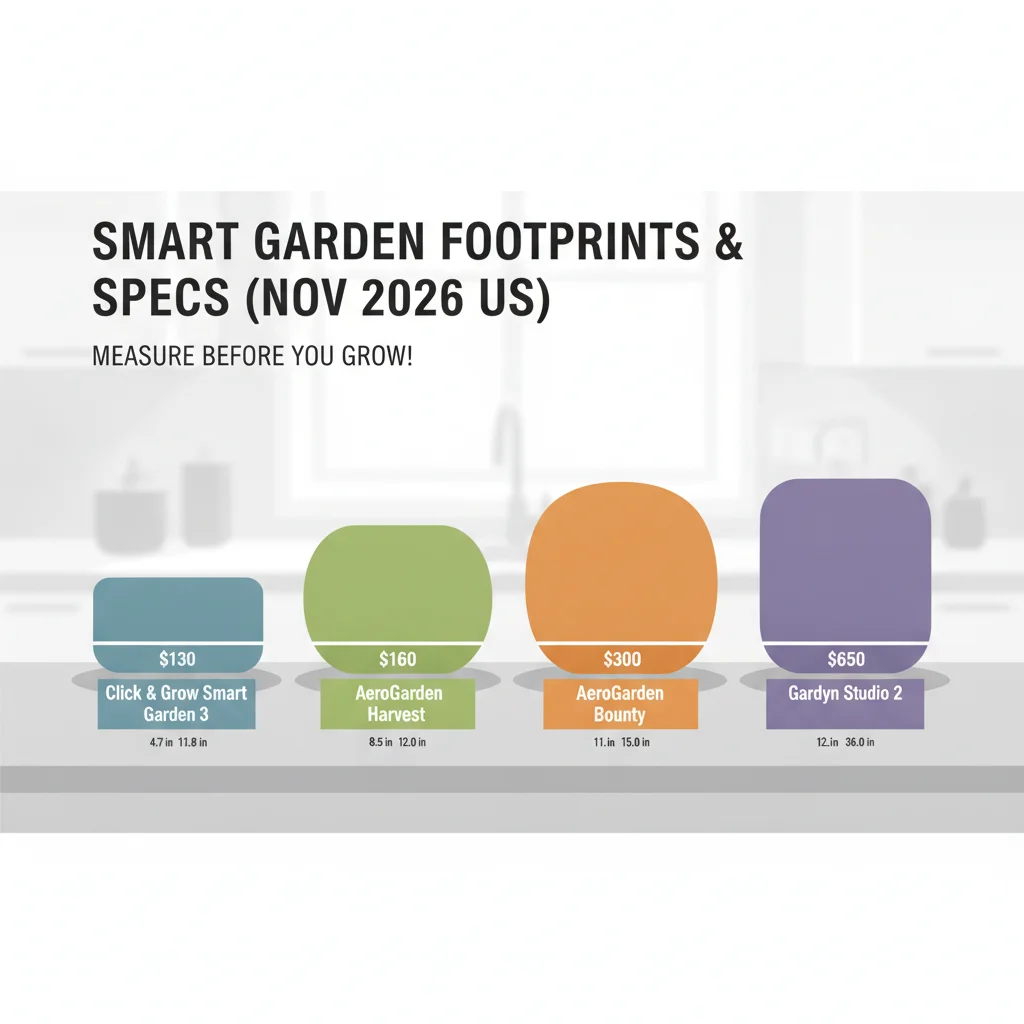
Click & Grow’s US store lists Smart Garden 3 at $124.95 with three plant sites. The spec table on that page is 300 mm wide, 120 mm deep, and 210–470 mm tall depending on the two lamp extension arms, 1.2 kg, 8 W, and 3.8 kWh per month. The same product page’s “how it works” block calls the tank 1.2 liters / 40 oz and “up to 3 weeks” of water; the spec table on that page says 1.5 liters. The dedicated specifications page lists 1.2 liters (0.32 US gal). The help-desk article lists 1.5 liters, up to 2 liters of water a month, a 7-year LED life, and a preferred room range of 20–24 °C (68–75 °F). Treat the tank as roughly 1.2–1.5 liters and refill from the float, not from a calendar.
Scotts lists AeroGarden Harvest at $76.97, marked down from $109.95, on 1–2 November 2026. Specs: 6 pods, matte black, 20 W LED, 10.5″ W × 6″ D × 17.4″ H, water and plant-food reminders, digital display, automated lights, grow height up to 12 inches. In the carton Scotts packs a six-pod seed kit plus a 3-fl oz bottle of AeroGarden liquid plant food. Scotts tells you to keep the bar a few inches above the canopy and to unplug the unit before cleaning. The garden is indoor-only. Harvest Elite, on a sibling Scotts page, adds a stainless finish, dimmable lights, and vacation mode; the base Harvest FAQ on the Harvest page says Elite is the version with vacation mode.
Sprout is the skinny hydroponic. Scotts’ spec block: 3 pods, 10 W LED, 10.5″ high × 3.5″ wide × 12″ deep, 10 inches of adjustable grow height, water and nutrient reminders, no Wi-Fi, no vacation mode. Copy on that page calls the pump “silent.” The black SKU showed out of stock when checked on 2 November 2026, so treat Sprout as a geometry option, not a guaranteed cart button. Twelve inches of depth is deeper than Click & Grow’s 120 mm (about 4.7 inches). A 3.5-inch width does not save you if the board is only 8 inches deep.
Bounty is the countertop that stops being a countertop appliance. Scotts lists 17.25″ W × 11.25″ D × 34″ H, 9 pods, 40 W LED, 24 inches of grow height, Wi-Fi, a color touchscreen, vacation mode, and a 6-inch trellis. Hardware showed $114.98, down from $229.95, and out of stock on the same check. Thirty-four inches of height will not sit under a standard wall cabinet. Eleven inches of depth eats a cutting board.
Gardyn Studio 2 is not a counter object. The shop comparison table lists 17″ W × 12″ D × 54″ H, 1.4 sq ft, 16 plants, one 52 W LED bar, one 8 MP inward camera, 26 kWh per month, sensors for water, humidity, and interior temperature, and 2.4 GHz Wi-Fi only (not 5 GHz). Hardware is $549. Home 4 on the same table is 24″ × 12″ × 64″, 2.0 sq ft, 30 plants, two 40 W bars, 47 kWh per month, $899. Indoor operating copy on that table allows 50–95 °F. That is a wider band than Click & Grow’s 68–75 °F help-desk window, and it still assumes a floor corner, a pitcher path to a sink, and a 2.4 GHz SSID your building Wi-Fi may not expose.
| System (US pages, 2 Nov 2026) | Sites / plumbing | Listed size | Power shown | Hardware price shown |
|---|---|---|---|---|
| Click & Grow Smart Garden 3 | 3 wick cups, no pump | 300 × 120 mm; lamp 210–470 mm | 8 W / 3.8 kWh per month | $124.95 |
| AeroGarden Harvest | 6-pod pumped bowl | 10.5″ × 6″ × 17.4″; 12″ grow height | 20 W LED | $109.95 list / $76.97 sale |
| AeroGarden Sprout | 3-pod pumped bowl | 3.5″ × 12″ × 10.5″; 10″ grow height | 10 W LED | Black SKU out of stock at check |
| AeroGarden Bounty | 9-pod pumped bowl, Wi-Fi | 17.25″ × 11.25″ × 34″; 24″ grow height | 40 W LED | $229.95 list / $114.98 sale, OOS |
| Gardyn Studio 2 | 16-site column pump | 17″ × 12″ × 54″; 1.4 sq ft floor | 52 W LED / 26 kWh per month | $549 |
Click & Grow’s US store lists the Smart Garden 3 at $124.95 with a 300 mm width, 120 mm depth, 8 W LEDs, and no pump.
Cabinet clearance is the filter most product photos hide
Smart Garden 3 packed with both extensions is 470 mm, about 18.5 inches. The help-desk figure with one extension is 13.4 inches; with none it is 8.3 inches. If the lamp must rise as basil stretches, the unit leaves the under-cabinet strip and needs an open counter, a fridge top, or a bookcase. Harvest’s 17.4-inch body with a 12-inch grow window is the same problem in a shorter cage: Scotts wants the bar a few inches above the leaves, so a full herb canopy uses the whole 17.4 inches and then some. Bounty’s 34-inch stack is a peninsula or table, not a galley slot.
Depth is the other rental constraint. Click & Grow’s 120 mm is a spice-rack depth. Harvest’s 6 inches still leaves a knife board in front on a 24-inch run. Bounty’s 11.25 inches and Gardyn’s 12-inch floor depth are furniture. Measure the outlet side too: Click & Grow lists a 1900 mm (6 ft 3 in) cable. A garden that only fits the back of the counter still needs a receptacle that a toaster does not already own.
Wick silence, bowl pumps, and why towers fail studios
Click & Grow is a wick appliance. Official copy: insert proprietary plant pods, add water, plug in. Lights are automated. The app is optional care tips and harvest reminders. Pods are pre-seeded; failed official pods get a free replacement. Nutrients live in coconut-coir “smart soil,” so there is no separate plant-food pour on official pods. The company says setup is 5 minutes and maintenance is 5 minutes a month, and that parts are dishwasher-safe. WIRED’s 2026 gallery puts Click & Grow in the silent camp with Auk and calls it one of the simplest watering systems in that set: a wick in the cup, roots in the cup, a bobber for the tank. The same write-up calls it one of the slowest gardens in the test — weeks to a lettuce leaf, and one lettuce pod never sprouted (the company replaces failed pods). Three-packs start around $15; the Smart Garden 3 page showed lavender and other three-packs at $14.95.
Harvest is an open nutrient bowl with a pump. You fill water, add liquid food, drop pods, and follow the panel. Scotts’ Harvest FAQ: buttons light red for water or food. There is no app requirement. WIRED’s notes on the larger Bounty family are the pump-sound warning that still applies to any AeroGarden bowl in a studio: the Bounty pump runs about every 30 minutes and is not loud until the water is at half or less, when it “sounds like a pet drinking water.” Lights on that family stay on about 16 hours. WIRED dropped the Bounty app after a week of it “forgetting” the garden; the on-unit screen still ran the schedule. Harvest itself is the no-Wi-Fi, no-vacation-mode sibling, which is a feature in a rental that does not want another 2.4 GHz client.
Gardyn is a vertical loop. Water is pumped up columns and returns to a tank. The shop page claims “under 15 minutes of care per week,” a free plant starter set, a 3-year warranty, and membership for Kelby. WIRED’s gallery groups Gardyn with Lettuce Grow as gardens that have loud pump cycles and tells readers not to put that class next to a TV or office. For a top-floor apartment, WIRED’s explicit pick for “any noise is a concern” is a totally silent garden such as Click & Grow or Auk. Studio 2’s 26 kWh per month is roughly seven times Click & Grow’s listed 3.8 kWh. That is manufacturer electricity, not a meter log, and it is the studio electric-bill argument without inventing a kilowatt-hour rate.
Scotts lists the AeroGarden Harvest at $76.97 on sale from $109.95, with six pods, a 20 W LED, and 12 inches of grow height.
North-facing kitchens still need the lamp, not the window
These kits are sold as indoor appliances. Click & Grow’s marketing even positions the 3 as a way to put plants “in that corner of your home that never gets any light.” The LED, not the window, is the light source. WIRED’s gallery-wide note is that garden lights typically run around 16 hours and are bright enough that you may want them away from a bedroom. In a studio that is one room, that means the kit belongs on the kitchen run or a hall shelf, not on the nightstand. Click & Grow’s 8 W draw is the low-glare, low-kWh end of this set. Harvest’s 20 W bar and Gardyn’s 52 W bar are brighter objects in the same small room.
Temperature is a separate rental problem. Click & Grow’s help desk wants 68–75 °F. A radiator studio that swings outside that band is outside the brand’s stated window; the page does not publish a yield penalty for that, so do not invent one. Gardyn’s 50–95 °F band is wider on paper. WIRED’s Rise Gardens notes (a different tower) saw herbs and lettuce bolt faster when the canopy ran hot; that is a heat-and-crop pattern from that review, not a measurement of Click & Grow. Keep the kit off a stove run. Scotts’ Harvest safety copy is indoor-only and tells you not to submerge the electronics.
Travel weeks, sockets, and what “smart” actually automates
Click & Grow’s US product page says the tank holds enough water for up to 3 weeks. That interval is why a wick tank is the travel appliance if you will not buy Harvest Elite’s vacation mode. You still dump stale water when you return. There is no impeller to seize while you are gone. There is also no nutrient blinker, because official pods do not get a bottle dose.
Harvest’s panel is the nagging layer: water, food, lights. Vacation mode is not on the base Harvest spec list. If you leave for ten days, you either top the bowl before you go and accept that Scotts does not publish a dry-tank survival time for this SKU, or you buy Elite for vacation mode, or you pick Click & Grow’s two-to-three-week tank. Bounty’s vacation mode is the feature that matches frequent travel — at the cost of 34 inches of height and a Wi-Fi client. Gardyn’s shop copy puts Vacation Mode behind membership; the hardware still waters and lights on a schedule, but the coaching stack is a subscription decision, not a counter-depth decision.
Wi-Fi is optional complexity in a building with captive portals. Harvest and Sprout list no Wi-Fi. Click & Grow’s app is optional. Bounty is Wi-Fi compatible. Gardyn requires 2.4 GHz 802.11n and is “not compatible with 5 GHz.” Many apartment access points ship 5 GHz-only guest networks. If you cannot split a 2.4 GHz SSID, Studio 2’s cameras and Kelby path are blocked even if the floor patch exists.
Pet households get a hard Scotts line on the Harvest page: some plants are toxic if ingested; keep the garden where animals cannot graze. That is a placement rule, not a brand ranking. A 4.7-inch-deep wick box is easier to put on a fridge than a 54-inch tower.
Gardyn’s shop table prices Studio 2 at $549 for 16 plants in a 17×12×54-inch tower that needs 1.4 sq ft and 2.4 GHz Wi-Fi only.
Three garnish sites versus six bowls versus a 16-plant column
Smart Garden 3 includes three basil pods, three germination domes, two lamp arms, and the tank. Click & Grow says any of 60-plus pods fit any of its gardens. Basil three-packs and mixes sit at $14.95–$29.95 on the same product page. Three sites are a garnish machine: pesto leaves, not a salad drawer. WIRED’s slow-growth note is the expectation setting. You are buying silence and a shallow footprint, not AeroGarden’s “5x faster than soil” claim, which is Scotts marketing language on Harvest and Sprout, not a third-party timing study cited here.
Harvest’s six sites are the cooking-kit size. Scotts says you can run salad greens and compact vegetables as well as herbs, and that the 6-pod Harvest is the brand’s most popular countertop garden. A Gourmet Herb kit is the usual box option on that URL. Owner reviews on the same page are mixed on germination: one 2026 review had only dill and one basil up after a month; another 2026 review called tracking and support a mess. Those are posted owner notes, not a lab count. The geometry argument still holds: six plants in 10.5 × 6 inches is the density step up from Click & Grow 3 without Bounty’s 11-inch depth.
Sprout’s own Scotts FAQ tells you to prune basil from the top so the 10-inch lamp can stay low until slower herbs catch up, and a 2021 owner review on that page says not to plant tall crops such as cilantro, dill, tomatoes, or peppers. Ten inches of grow height is a microgreen and compact-herb cage. Treat Sprout as a windowsill hydroponic, not a pepper box.
Gardyn Studio’s shop FAQ says the compact tower is for apartments, condos, or a smaller daily supply, with a manufacturer maximum of “up to 5 lbs” a month. That “up to” is a company ceiling, not a kitchen scale. Home 4’s “up to 10 lbs” is the same kind of maximum. WIRED’s long-term Home 4 notes (the bigger sibling) describe column scrubbing, root checks, and a reset that scored poorly when sections were skipped. Studio 2 is smaller, not chore-free. Sixteen plants also means sixteen yCubes over time. The tower wins only if you already decided salad volume beats counter space.
Year-one money, hardware only, as listed on 2 November 2026: Click & Grow 3 $124.95 plus about $15 each time you restock three pods; Harvest $76.97 on the sale price plus later 6-pod kits and liquid food; Studio 2 $549 before membership. Arithmetic on listed watts, not a utility bill: Click & Grow publishes 3.8 kWh per month; Harvest does not publish kWh, only 20 W; Studio 2 publishes 26 kWh per month. A nine-pod bowl or a 24-inch fruiting lamp is a different footprint; start from the published smart indoor garden 2026 hub if garnish on a kettle board is no longer the job.
Who should still buy a tall light or a floor column
Buy Bounty if tomatoes and peppers are the point and you have a table that can hold 17.25 × 11.25 inches and 34 inches of lamp. Scotts positions the Bounty family for fruiting height; Harvest’s 12-inch bar is the compact alternative. Vacation mode and the touchscreen are the travel and control extras. Stock was out on 2 November 2026 at $114.98 sale, so the buy is a restock watch, not a same-day cart.
Buy Gardyn Studio 2 if you have 1.4 sq ft of floor, will join 2.4 GHz Wi-Fi, accept 26 kWh per month, and want sixteen sites more than you want a free cutting board. Gardyn’s own shop copy points apartment dwellers at Studio rather than Home. That is still a piece of furniture. WIRED’s noise warning for Gardyn-class pumps is the upstairs-neighbor test. If that test fails, the silent wick wins even if you wanted more plants.
Do not buy any of these as a humidifier. Dry winter kitchens brown herb edges because the room is dry. The published bedroom humidifier guide is the climate tool; none of these gardens list a humidification function. Click & Grow’s 68–75 °F note and Gardyn’s 50–95 °F band are temperature, not moisture.
For a galley rental that cooks with basil, cilantro, and parsley, the purchase that matches the slot is Click & Grow 3 when silence and 4.7 inches of depth matter, and Harvest when six circulating pods and a $76.97 sale board matter more than pump ticks. Everything taller is a different room.
Frequently Asked Questions
Which kit actually fits a small apartment counter?
Click & Grow Smart Garden 3 is 300 mm wide and 120 mm deep. AeroGarden Harvest is 10.5 inches wide and 6 inches deep. Both sit on a standard 24-inch run. Bounty needs 11.25 inches of depth and 34 inches of height. Gardyn Studio 2 needs 1.4 sq ft of floor, not a counter.
Do I need a sunny window for these indoor gardens?
No. Click & Grow sells Smart Garden 3 for corners that never get light, and Scotts’ Harvest copy is built around the 20 W LED, not a sill. WIRED notes typical garden lights run about 16 hours and are bright, so keep the kit out of the sleeping zone in a studio.
Which system is quiet enough for a top-floor rental?
Click & Grow has no pump. WIRED’s 2026 gallery names Click & Grow and Auk as the silent options when any pump noise is a problem, including a top-floor apartment, and groups Gardyn with louder pump-cycle towers. Harvest is a pumped bowl; Bounty’s pump is quiet until the water is low, then WIRED compared it to a pet drinking.
What happens if I travel for a week?
Click & Grow’s tank copy is up to two or three weeks between fills. Base Harvest has water reminders but no vacation mode; Harvest Elite and Bounty add vacation mode on Scotts’ pages. Gardyn puts Vacation Mode behind membership. None of those pages publish a guaranteed dry-tank survival time, so top the reservoir before you leave.
Is a 16-plant tower better if I only have a studio?
Only if you have 17 × 12 inches of floor, 54 inches of height, 2.4 GHz Wi-Fi, and budget for $549 plus 26 kWh per month. Gardyn markets Studio 2 at apartment buyers. For garnish on a kettle board, three wick sites or Harvest’s six pods match the furniture you already have.