The best indoor garden that actually works is the one whose water still reaches the roots after week three: a Click & Grow wick that stays soaked, or an AeroGarden bowl you refill when the panel turns red. A 12-inch Harvest does not become a tomato farm just because the box shows fruit.
This guide uses manufacturer troubleshooting, not a Smart Living IQ grow log. Sources checked 5 November 2026: Click & Grow’s dry-pod wick article, the Smart Garden 3 and Smart Garden 9 US listings, Scotts Miracle-Gro’s AeroGarden size table, the Harvest and Bounty product pages, AeroGarden FAQs, Scotts’ indoor tomato and pepper notes, Gardyn’s Home vs Studio shop table, Gardyn membership pricing, Gardyn’s pump troubleshooting article, and WIRED’s September 2026 indoor-garden gallery. Brand-by-brand plumbing sits on the published AeroGarden vs Click & Grow vs Gardyn comparison; mixed-kit ranking sits on the smart indoor garden 2026 hub.
Buy Click & Grow Smart Garden 3 if you will keep two thirds of the wick in water and three basil sites are the whole job. Buy AeroGarden Harvest if you will answer the red water light and stay inside a 12-inch lamp. Buy Bounty or Gardyn Home 4 only if you accept a taller cage or a floor column, plus the chores those pages list. Store herbs stay cheaper if you will not refill, prune, or replace a clogged wick.
Dead plants usually mean the water path stopped
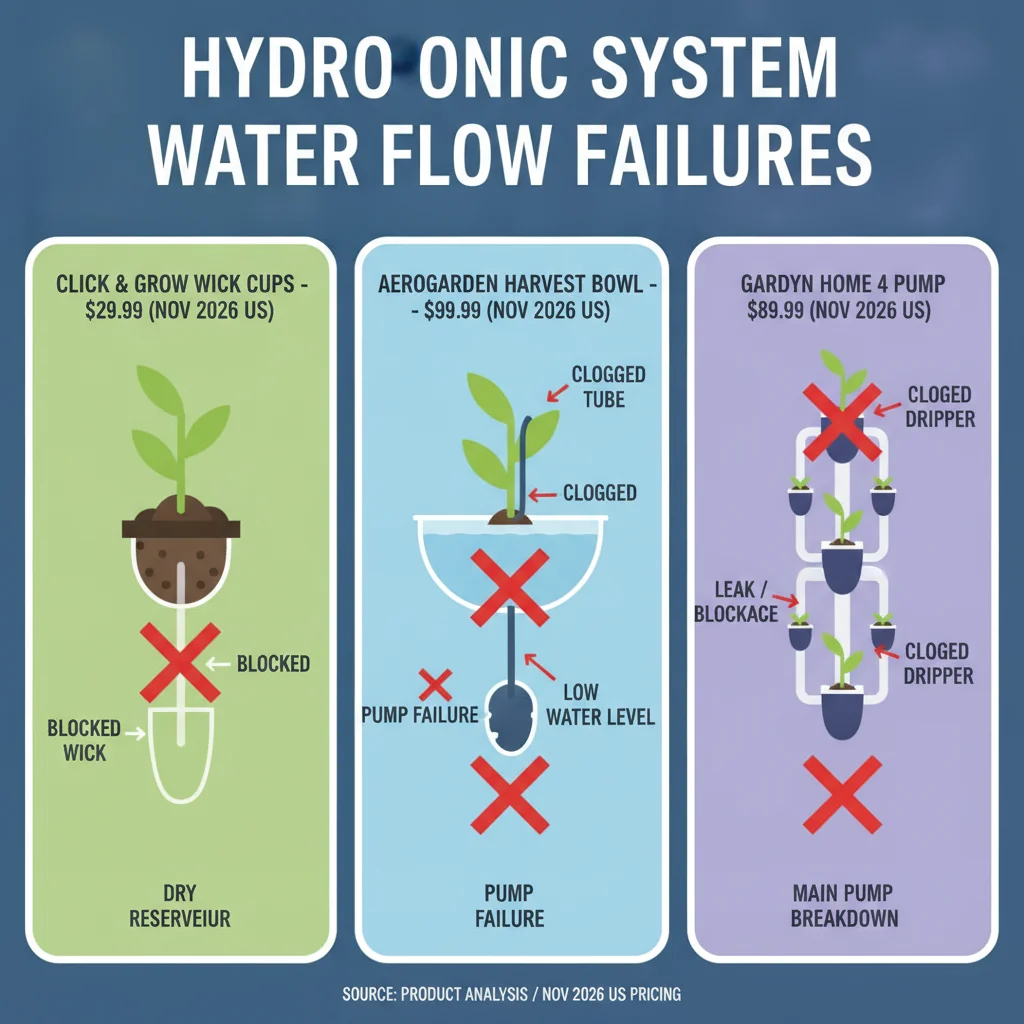
Click & Grow does not circulate nutrient solution. Official copy on Smart Garden 9 says plant pods sit in cups with wicks, the 4-liter tank lasts up to three weeks, LEDs run 16 hours on and 8 hours off, and there is no pump. Smart Garden 3 is the same plumbing in a 300 × 120 mm box with a 1.2–1.5 liter tank (the product table says 1.5 liters; the “how it works” block says 1.2 liters / 40 oz). When the soil looks dry while the float still sits high, the brand’s own article lists four causes: the wick is pulled out of place, hard water or roots have clogged it, the float is stuck so you think the tank is full, or the pod is root-bound and the coir has lifted off the wick.
That article is dated 5 February 2021 and still matches the current cups. Click & Grow tells you to pull the wick into position, even with pliers, and to replace clogged wicks every one to two years depending on water quality. Two thirds of the wick should stay immersed. Empty cups clog faster because there is no soil to take the water; if you leave a hole open, remove the cup and cover the hole so light does not hit the tank. Root-bound plants get swapped using the “lasts up to” date on the pod, the app, and the product page.
Click & Grow tells owners to keep two thirds of the wick immersed and to replace clogged wicks every one to two years.
AeroGarden is the opposite plumbing. Roots sit in a bowl. Scotts’ gardens hub says you top off water every 1 to 2 weeks, add liquid plant food every two weeks, and do a full change about once a month (every 2 to 3 weeks for fruiting plants). The FAQ says fill to the “Fill to Here” line, check that the pump or aerator is running, and keep the LED panel a few inches above the canopy. Harvest’s own page: press-and-hold the leaf button to run the pump for one minute if you think it stalled. Sprout shuts the pump and light off when the bowl is empty, then may take movement to restart after you refill. Roots through the grow-deck nozzles are a listed flow failure; Scotts tells you to split the deck at the tabs and scrub.
Tomato notes on the same site are harsher than the herb FAQ. Fast canopies empty a hydroponic reservoir overnight if you still refill on a salad calendar. “Dead tomato plants produce no fruit.” That is Scotts’ sentence, not a kitchen diary. The same page wants a complete water change every two weeks for fruiting plants, tighter than the generic monthly rinse-and-refill in the FAQ.
Gardyn moves water with a pump, not a wick. Help article 1788865 (edited 4 November 2026) starts from dry yCubes: toggle watering on in the app, pull a top yPod, and watch whether water reaches the column. If you hear the pump but nothing trickles, the hoses or splitter are next. If you hear nothing, reboot the tank switch, wait five minutes, then lift the pump holder three or four times because a low tank can airlock the impeller. Home 1–4 and Studio lids use different connectors; the article is explicit that pulling the wood top off the lid voids the warranty. While you wait on support, Gardyn points to a separate “watering by hand” page. That is a tower with a service path, not a set-and-forget appliance.
What independent testers saw when water or light went wrong
WIRED’s September 2026 gallery is Kat Merck’s home test, updated that month with more Gardyn notes. Click & Grow Smart Garden 9 was one of the slowest gardens in that set: weeks for a lettuce leaf, one lettuce pod that never sprouted, a handful of leaves at harvest. The float is described as a bobber that drops when the tank is low. Merck also flags the 9 as out of stock in that write-up; the US store on 5 November 2026 still listed it at $174.97, marked down from $249.95, so treat stock as a cart check, not WIRED’s snapshot.
On AeroGarden Bounty, Merck timed the pump at about every 30 minutes and said the garden sounds like a pet drinking once the water is at 50 percent or less. Lights about 16 hours. The app forgot the garden after a week; the on-unit screen still ran the schedule. A Salsa Garden kit of six tomato pods and three jalapeños germinated, then the tomatoes buried the peppers. That crowding is a crop-mix failure, not a broken pump.
Gardyn Home 4 is WIRED’s 9/10 pick and also the unit Merck says you will regret if you skip chores. Once a month the base needs emptying and scrubbing. Every few weeks, roots need a check for rot, a prune, or tucking back into the yPod. Reset after a planting is scored 2/10; skip the two-week root pass and Merck says it can drop to 1/10. Studio 2 plants were less lush than Home because Studio has one 52 W bar instead of two 40 W bars. Non-sprouting yCubes were replaced on request. That is someone else’s year with two towers, not ours.
WIRED’s 2026 gallery called Gardyn’s monthly tank scrub laborious, and said skipping root checks makes the next planting a miserable reset.
The lamp cage is the second way a kit “does not work”
Scotts’ gardens hub is a four-row table. Sprout: 3 pods, 6 inches of grow height, herbs and compact plants. Harvest family: 6 pods, 12 inches, herbs, lettuce, small fruiting plants. Bounty family: 9 pods, 24 inches, tomatoes, peppers, larger harvests. Farm 12XL: 12 pods, adjustable, “maximum yield.” Lettuce 3 to 4 weeks; herbs 4 to 6 weeks; tomatoes and peppers 8 to 12-plus weeks. Use every other hole for fruiting plants. Those numbers are manufacturer geometry. They are why a Harvest that germinates a compact vegetable kit still fails as a salsa machine: the bar has nowhere to go.
Scotts’ hydroponic gardens table assigns Harvest 12 inches of grow height for herbs and lettuce, and Bounty 24 inches for tomatoes and peppers.
Harvest’s spec block on 5 November 2026: 6 pods, 20 W LED, 10.5″ W × 6″ D × 17.4″ H, grow height up to 12 inches, water and plant-food reminders, $76.97 from $109.95, Gourmet Herb kit and a 3-fl oz nutrient bottle in the carton. Keep the bar a few inches above the plants. Unplug before cleaning. Indoor only. Harvest Elite adds stainless, dimmable lights, and vacation mode; the Harvest FAQ says Elite is the vacation-mode version. Harvest Lite sat at $99.95 on the same hub. Vacation mode is listed for Harvest Elites, Bountys, and Farms, not for base Harvest.
Bounty on the hub showed $114.98 from $229.95. Sibling Bounty copy on Scotts lists 17.25″ × 11.25″ × 34″, 40 W, 24 inches of grow height, Wi-Fi, color touchscreen, vacation mode, 6-inch trellis. Bounty Elite $274.95. WIRED splits Bounty Elite (vacation mode, 50 W in that gallery, color touchscreen) from a Basic with 30 W lights and fewer extras; buy against the Scotts SKU in the cart, not against WIRED’s nickname for the cheaper nine-pod.
Click & Grow Smart Garden 3 is 8 W, 210–470 mm tall with two extension arms, about 18.5 inches of whole appliance at full stretch. Smart Garden 9 is 604 × 396 × 184 mm and 13 W / 6.2 kWh per month. The 9’s starter carton includes basil, green lettuce, and Mini Tomato pods. That mix is a height fight inside a 396 mm lamp cage. Mini Tomato is a determinate dwarf on Click & Grow’s own timeline; it is still fruit, and basil you fail to pinch will shade lettuce. “Works” for that box means garnish herbs if you prune, not a grocery tomato vine.
LetPot LPH-SE in WIRED’s gallery is the Amazon-shaped 12-hole bowl with a 16-inch top lamp Merck called too short for tomatoes and peppers. Chard worked. The app’s 16-hour window did not stick on that tester, so lights were switched by hand. Cite it as a short-lamp success on greens, not as a fruiting substitute for Bounty.
Algae, germination guarantees, and the chores on the box
Scotts’ hub lists four “common problems”: white fuzz on sponges (usually fades as plants outgrow the label), green algae when light hits the water (cover unused holes with spacers or a golf ball, per the FAQ), slow sprouting from a low bowl or lights off, fungus gnats from overfilling. The FAQ also says white fuzz can be a beneficial fungus and is edible-plant safe. Algae in the bowl is called harmless to plants; you still cover holes if you want less of it. Between plantings, sanitize with a quarter cup of bleach in water or five cups of white vinegar, run 5–15 minutes, rinse, then a 1:10 bleach soak if you want a harder reset. Grow decks are top-rack dishwasher safe on that page. LED diodes are given a 2–4 year lifespan.
Official AeroGarden seed kits: most germinate in 5 to 15 days; 21 days with no sprout is the Germination Guarantee ticket. Grow Anything kits, where you supply seed, are not covered. Lights start low so seeds get heat, then rise with the canopy. Prune no more than one third of a plant at a time. Basil germinates first; Scotts tells you to cut it so slower herbs still see the bar. Thyme is called out elsewhere in Scotts troubleshooting as a three-week sprout. None of that is a 12-month household log. It is the brand’s own sequence for why a mixed Gourmet kit looks “dead” in week two when only basil moved.
Owner reviews on the Harvest URL are mixed in public. A 16 September 2026 one-star signed Mistypilgrim reports algae, mold, and no germination after following directions. An 28 October 2026 one-star signed Weezegan reports nothing from the pods after four weeks on a third AeroGarden. Those are dated comments on Scotts’ page. They are not a germination rate. They are a reminder that a 21-day guarantee exists because pods do fail, and that algae shows up when light hits a still bowl.
Click & Grow’s US copy says 5 minutes a month, dishwasher-safe parts, and a free replacement if a pod does not sprout. Smart Garden 3 includes three basil pods. Smart Garden 9 includes the three-crop starter. Official three-packs showed $11.96 from $14.95 on 5 November 2026. The app is harvest tips, not a pump controller. WIRED’s slow lettuce is the independent check on “foolproof” wick speed: the plumbing is simple, the calendar is not grocery-fast.
Gardyn’s shop table still claims “under 15 minutes of care per week.” Membership FAQ on 5 November 2026: hardware runs without a plan; Home membership is $39 a month (10 yCube credits), Studio $25 a month (5 credits); 30-day trial in the app; prepaid 1- and 2-year options exist; non-members buy yCubes from $4.99 plus $9.99 shipping; members from $1.99. Vacation Mode sits behind membership. WIRED quoted about $259 a year plus credits; the membership page’s monthly Home number is $39, which is $468 if you stay month-to-month. Use the page you are quoting. Kelby is cameras plus a coach; Merck notes privacy write-ups in 2026 and CISA advisories on Home and Studio, with Gardyn telling owners to run firmware 619 or later. A tower that “works” in that gallery still assumes you will scrub columns and keep 2.4 GHz Wi-Fi. Five-gigahertz-only apartment routers are a documented miss on the shop table.
What the US carts showed on 5 November 2026
| System (US pages, 5 Nov 2026) | Water path | Grow limit on the spec sheet | Listed hardware price | Failure the brand or WIRED documents |
|---|---|---|---|---|
| Click & Grow Smart Garden 3 | Wick, 1.2–1.5 L, no pump | Lamp 210–470 mm; 3 sites | $99.96 (was $124.95) | Dry coir while the float still looks full |
| Click & Grow Smart Garden 9 | Wick, 4 L, no pump | 604 × 396 × 184 mm; 9 sites | $174.97 (was $249.95) | Slow greens in WIRED; Mini Tomato vs basil height fight |
| AeroGarden Harvest | 6-pod bowl, timed pump | 12 in grow height; 10.5 × 6 × 17.4 in | $76.97 (was $109.95) | Empty bowl, stalled pump, algae in open holes |
| AeroGarden Bounty family | 9-pod bowl, timed pump | 24 in grow height; ~34 in tall unit | $114.98 sale on hub; Elite $274.95 | Overnight dry-down on fruiting plants; crowding |
| Gardyn Studio 2 / Home 4 | Column pump loop | 54 in / 64 in open pipes; 16 or 30 plants | $549 / $899 | Airlocked pump; skipped root tucks; 2.4 GHz only |
Electricity on those pages is a watt or kWh line, not a utility experiment: Smart Garden 3 8 W / 3.8 kWh a month; Smart Garden 9 13 W / 6.2 kWh; Harvest 20 W; Bounty 40 W on Scotts, 40–50 W on WIRED’s Elite table; Studio 26 kWh; Home 47 kWh. Do not invent a kilowatt-hour rate on top. Herb kit geometry and six-pod Gourmet layouts belong on the published hydroponic herb garden guide.
Refill math is public list price, not a savings study. Click & Grow three-packs at $11.96 sale are about $4 a site before tax. AeroGarden Grow Anything and Gourmet kits rotate on Scotts’ seed catalog; Harvest’s carton already has one 6-pod kit and 3 oz of food. Gardyn non-member yCubes from $4.99 plus shipping are the no-plan path; $39 a month is the Home plan that bundles 10 credits and Kelby. Hardware “that works” still bills you for pods after the starter pack.
Buy the kit that matches the failure you will not tolerate
If silence and no impeller matter more than speed, Click & Grow is the documented match. Keep the tank topped so two thirds of the wick stays wet. Replace wicks on the 1–2 year cadence if your water is hard. Cover empty holes. Treat Smart Garden 3 ($99.96 sale) as three basil sites in a 120 mm-deep strip. Treat Smart Garden 9 ($174.97 sale) as nine silent cups whose Mini Tomato starter will fight lettuce unless you prune. WIRED’s handful-of-leaves result is the yield expectation for that wick, not a defect unique to one reviewer.
If you want circulating hydroponics and a red reminder light, Harvest is the cheap bowl that Scotts actually sizes for herbs and lettuce. $76.97 on 5 November 2026. Answer the water LED. Run the one-minute pump test if the bowl is still. Cover unused holes. Use the 21-day germination ticket instead of assuming the kit is broken on day eight. Do not buy Harvest to replace a tomato vine; the size table already sent that crop to Bounty.
If the job is cherry tomatoes or peppers, the documents that “work” are Bounty’s 24-inch cage plus a 6-inch trellis, or Gardyn’s open column. Scotts wants every other hole empty, a shake or a fan on open flowers, and water checks that match a thirsty canopy. Gardyn wants a 24 × 12 × 64-inch Home 4 at $899 (or Studio 2 at $549 if 16 plants and one bar are enough), 2.4 GHz Wi-Fi, and the pump test in article 1788865 when yCubes go dry. Membership is optional for lights and watering; Kelby, Vacation Mode, and cheap credits are not. WIRED’s Home 4 success sat next to a 2/10 reset score. That pairing is the honest sales pitch.
If you travel, read the vacation-mode list before you pay for Wi-Fi. Scotts: Harvest Elite, Bounty, Farm. Gardyn: membership. Click & Grow: a 4-liter tank that still needs the wick wet; there is no impeller to pause. Base Harvest’s FAQ does not give you vacation mode. Leaving a pumped bowl on a two-week trip is how Scotts’ tomato page describes overnight death, just stretched across a calendar.
If you only need parsley twice a week, a $3 clamshell still “works” and has no wick to clog. These appliances pay for themselves only if you use the harvest and do the listed water job. This page does not invent a break-even month. It maps the failure each brand already wrote down, then points the cart at the hardware whose failure mode you will actually prevent.
Frequently Asked Questions
Why is my Click & Grow soil dry when the float looks full?
Click & Grow’s wick article lists a wick pulled out of the cup, a wick clogged by hard water or roots, a stuck float, or a root-bound pod that has lifted off the wick. Seat the wick, tap or clean the float, and replace wicks every one to two years. Keep two thirds of the wick in water. Cover empty holes so light does not hit the tank.
Why did my AeroGarden seedlings stall after a good first week?
Scotts’ FAQ wants a running pump or aerator, water at the Fill to Here line, and lights a few inches above the canopy. Basil often outruns thyme and parsley; prune the basil so the bar can stay low. Unused holes grow algae if you skip spacers. Pods with no sprout after 21 days are a Germination Guarantee case on official kits, not on Grow Anything seed you supplied.
Can I grow tomatoes in a Harvest or Smart Garden 3?
Scotts files tomatoes and peppers on the Bounty/Farm row (24-plus inches). Harvest is 12 inches with no trellis in the box. Click & Grow Smart Garden 3 is an 8 W cage 210–470 mm tall. Mini Tomato pods exist for that cage as determinate dwarfs; they are garnish fruit on a 90-plus day calendar, not a Harvest-sized salsa kit. Buy Bounty or a Gardyn column if fruiting is the job.
Does Gardyn work if I skip the membership?
Gardyn’s membership FAQ says lights and watering run without a plan. Home membership is $39 a month with 10 plant credits; Studio is $25 with 5. Non-members pay from $4.99 a yCube plus shipping. Vacation Mode and Kelby sit on the paid side. The pump article still applies either way: dry yCubes mean you test flow, reboot, and burp an airlocked impeller.
When should I just buy herbs at the store?
When you will not refill a tank, pinch basil, or replace a clogged wick. Click & Grow’s own dry-pod article and Scotts’ empty-reservoir tomato warning are the unpaid jobs. A $76.97 Harvest or a $99.96 Smart Garden 3 only beats a clamshell if those chores happen. This page has no household cost log that proves a break-even date.